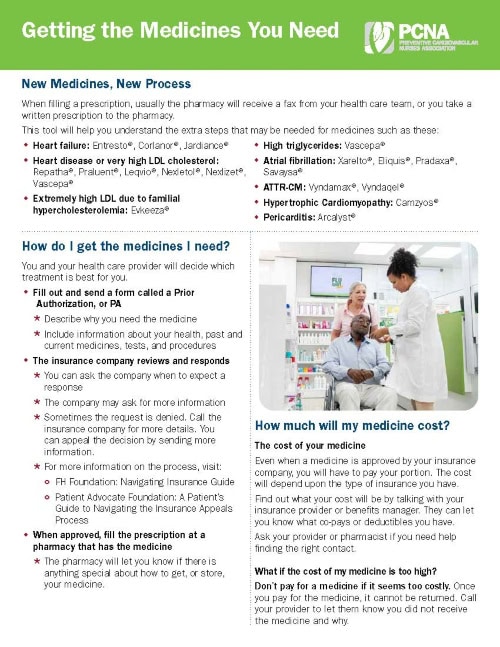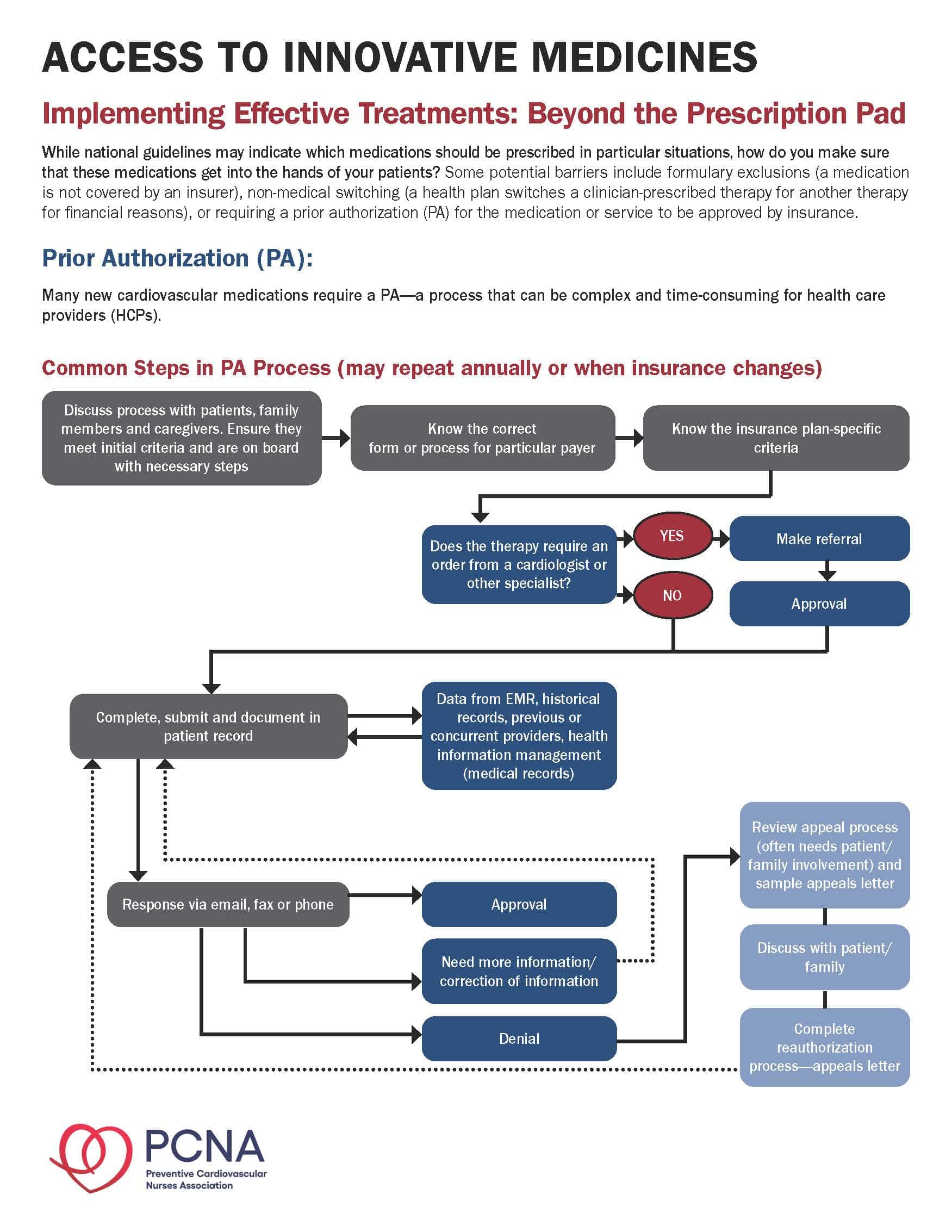







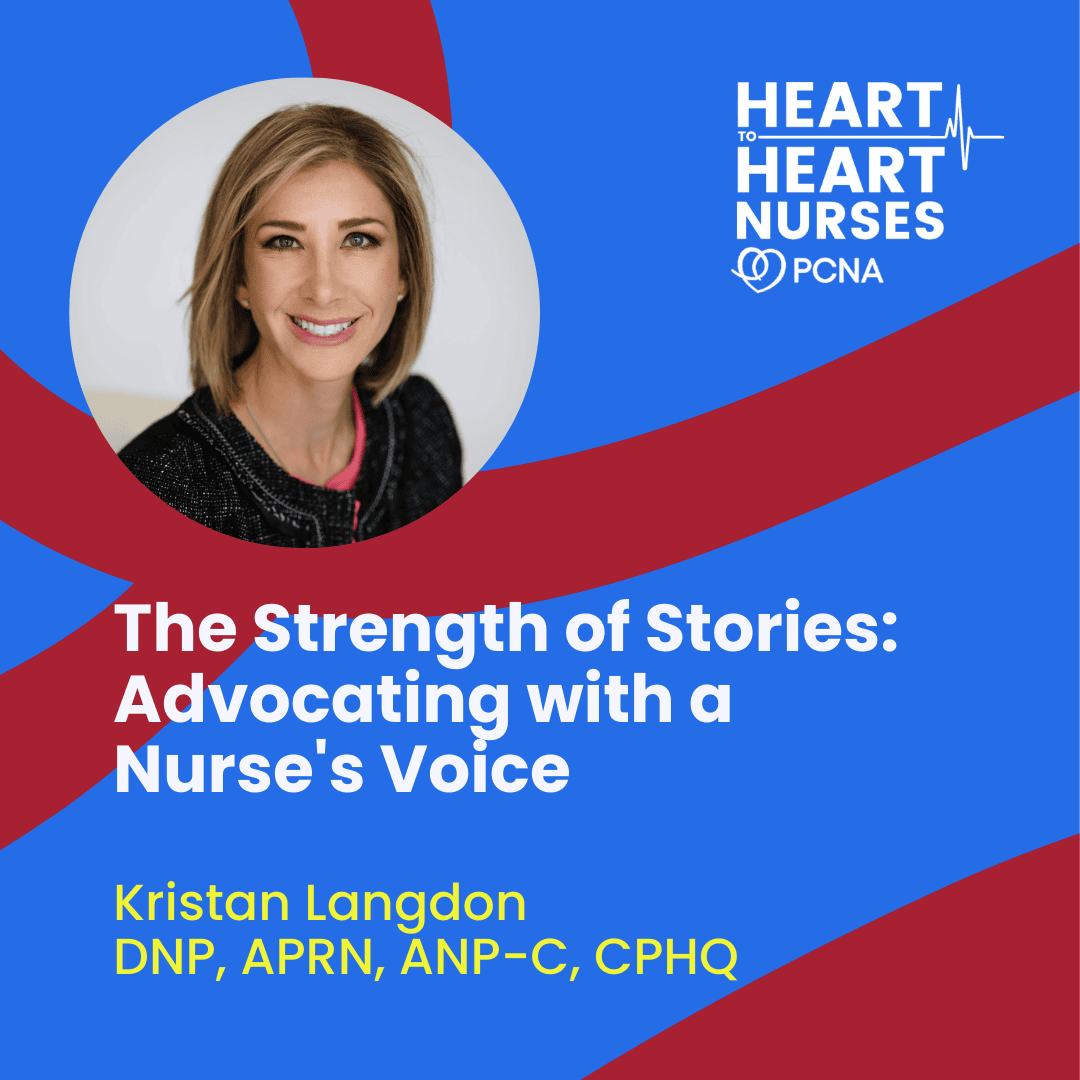
Sharing stories about the work nurses do carries weight with decision-makers. Guest Kristan Langdon, DNP, APRN, ANP-C, CPHQ, emphasizes the importance of communicating your first-hand experiences in compelling conversations at the local, regional, state, and national level.
Episode Resources
Kristan Langdon podcast episode transcript
[00:00:00] I’m Erin Ferranti, board president for PCNA, and I’d like to welcome you to this episode of the Heart to Heart Nurses Podcast. PCNA is the proud home of cardiovascular nurses and one of the leading figures in the fight against cardiovascular disease. We have the resources you need for your day-to-day practice or to follow your passion to new areas of learning and growth.
Geralyn Warfield (host): (00:20)
Well, we are so excited to welcome our audience today where we have the great opportunity to speak with Kristen Langdon. Kristen, could you introduce yourself?
Kristan Langdon (guest)
Thank you, Geralyn. I’m Kristen Langdon. I’m a nurse by profession and a nurse practitioner, primarily. Always in cardiovascular care. And now I do more work that’s actually on the clinical quality side. So, looking at all of the work that we were doing, but spanning it across a wider (00:57)
section to have greater impact. And really, how we change health care towards ways that are dynamic and adaptive.
Geralyn Warfield (host): (01:05)
Excellent. Well, I’m wondering how you got started in this field of advocacy and ensuring that individuals have access to care and the kinds of things that you’re working on. How did you get your start?
Kristan Langdon (guest) (01:16)
So, after I graduated from nursing school, I actually moved back home to Colorado. And at that time, the group that was there within the Colorado Nursing Association was extremely active in advocacy, particularly at the advanced practice level. And so, coming in amongst other colleagues that were really driving initiative working at that time, it had to do with full practice authority.
And so, we had great components. Tay Kopanos was there at the time within Colorado Nurses Association and really drove a lot of that work along with the other leaders. And so really for me, when I came into that environment, put forward that this was not an option. This is part of professional work that you advocate at your state level, your national level. We do it all the time as nurses. And so, it fit very beautifully into how I entered into the profession of nursing.
Geralyn Warfield (host): (02:17)
I think you’ve definitely hit on an important topic, which is we do this every single day. We just don’t recognize it as advocacy necessarily. And so, it also is very obvious to those of us that are in the field what we do and its importance. But to those outside of the field, they don’t really understand it. They might touch on the health care system, maybe in primary care, maybe in the emergency room or some other setting, but they don’t really have the whole picture.
So that kind of demonstrates to me the importance of sharing our voice and sharing our stories. Would you agree that that’s important?
Kristan Langdon (guest) (02:49)
Exactly. That storytelling really coming from the perspective. Nurses have wonderful stories about how they see healthcare unfolding, patient stories, particularly around barriers to care or things that are incessant that we’re really seeing are preventing us from meeting the goals and objectives that we see for a change in healthcare.
And I would say even the value-based as we look at healthcare and how it’s delivered. A lot of the (in)consistency and gaps are still there.
And the people who are making the laws, a lot of times don’t have, they’re not from a healthcare background, like you just mentioned. And so, stepping up and really speaking and feeling that we have value in what we’re saying, because I feel like that is what happens. Most often is that people don’t feel like they belong, this is not their space as nurses. And it truly is, because we understand stories, we understand patients and we understand healthcare really well.
Geralyn Warfield (host): (03:54)
I think the other thing that we forget as we’re involved in our daily work is that nurses are the top trusted profession in the United States. And if it’s not information that’s coming from a nurse, then where else can it come from to be more trusted? So, I think that value is sometimes we forget how valuable we really are. So, I appreciate you sharing that.
Now you’ve been involved in the advocacy space for a while. What kind of changes have you seen throughout your time working in advocacy?
Kristan Langdon (guest) (04:20)
Definitely more of interdisciplinary and coalition work. I think we’re at a point in time that going out as an individual organization typically is not where we’re going to see change. And so, collaborating—particularly across interprofessional spaces—I feel is very valuable in coming forward with different issues and how they’re impacting different aspects.
And we can really speak to different focuses as well, because that’s what it comes down to. What’s important to the people that we’re speaking to and how we can tell that story in a way that resonates with them.
Geralyn Warfield (host): (04:59)
We’re going to take a quick break and we will be right back.
Geralyn Warfield (host):
I’d like to welcome our audience back to our conversation with Kristin Langdon and we’re talking about advocacy and the importance of nurses being involved. And Kristin, what kind of clinical pearls do you have for us? What kind of takeaways for our nursing people that are watching or people that are listening that how they can get involved or things that you think are important for them to know?
Kristan Langdon (guest) (05:20)
I think it’s important for us to all know that advocacy is part of our responsibility, not just as healthcare providers, but also as patients. So, when there’s things that are impacting us, we feel it can be different, making sure that we’re voicing our opinions and really coming with the background to share that. Because legislators typically do not come from the field. They don’t know particular independent stories and/or collective stories. And so, ways that we can share that with them in their decision making is always impactful and helpful.
Geralyn Warfield (host): (05:56)
And is there an easy way for individuals to find out who their legislators are?
Kristan Langdon (guest) (06:00)
There is, you can go onto the .gov site and it gives you a link directly to your state and national representatives, both within the Senate and the House of Representatives. It’s an easy link by just putting in your zip code. It gives you that direct link.
Geralyn Warfield (host): (06:17)
Well, it sounds like it’s very easy to get involved. You just have to take a moment to share your story and share your voice. Are there any other clinical pearls that you would like to share or anything else that we’ve missed talking about today?
Kristan Langdon (guest) (06:28)
That you can always support others in the work, too. So, the easiest question to ask is how can I help? And that leads you right into a lot of advocacy work.
Geralyn Warfield (host): (06:39)
I love that. So, I have one quick question for you and that one final question I should say, and that is, is there one key takeaway that you would like our audience to know about?
Kristan Langdon (guest) (06:49)
I’d say, just getting your voice in room at any setting. Knowing what is important to you and how you can voice that for the larger good.
Geralyn Warfield (host): (06:59)
Kristin, thank you so very much for empowering our audience in what to say, how to say it, and feeling compelled to do the action that’s needed to help everybody understand our work and its importance across the country and across the globe.
This is your host, Geralyn Warfield, and we will see you next time.
Thank you for listening to Heart to Heart Nurses. Visit PCNA.net for clinical resources, continuing education, and much more.
Topics
- Advocacy
Published on
March 17, 2026
Listen on:
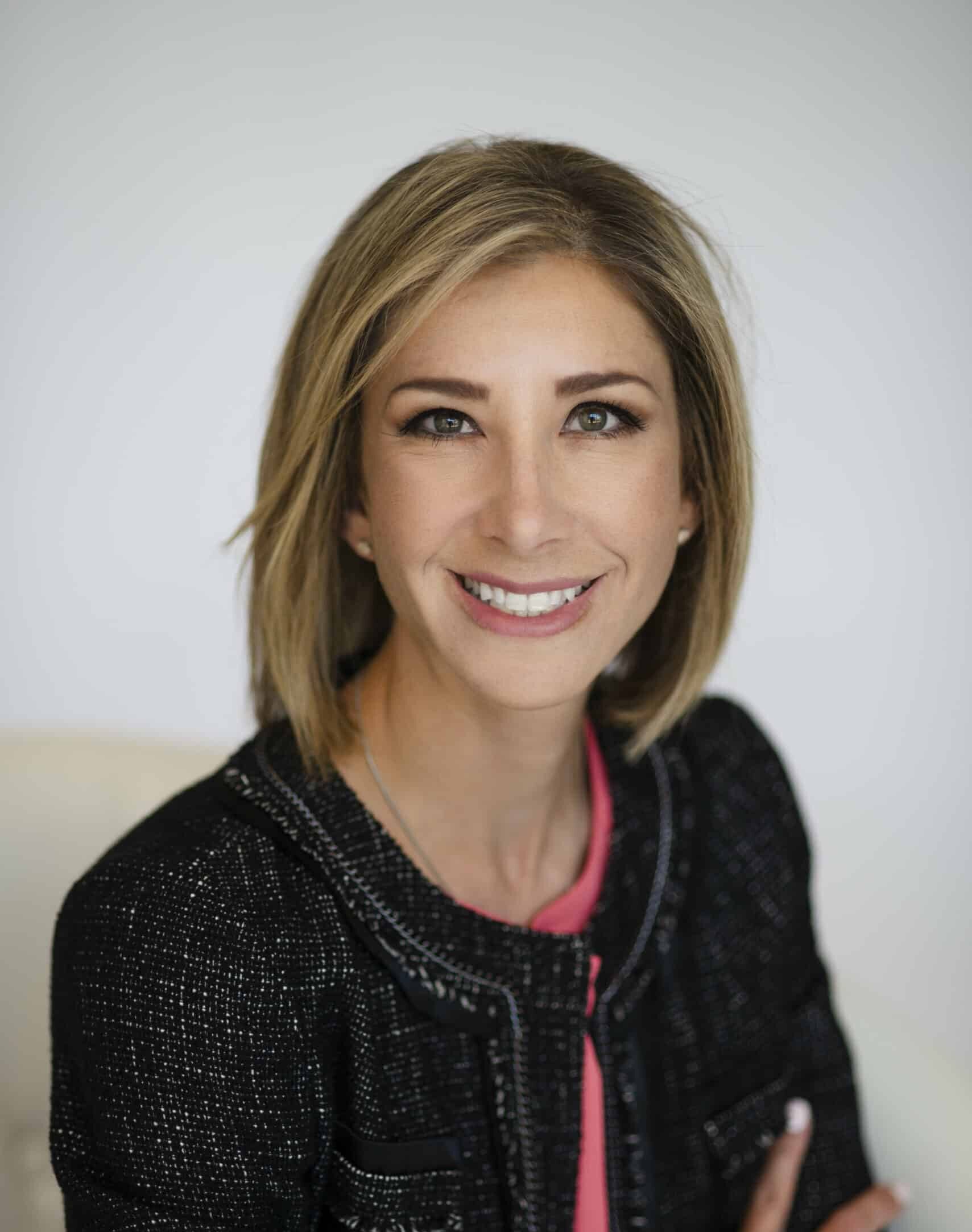
DNP, APRN, ANP-C
Related Resources