






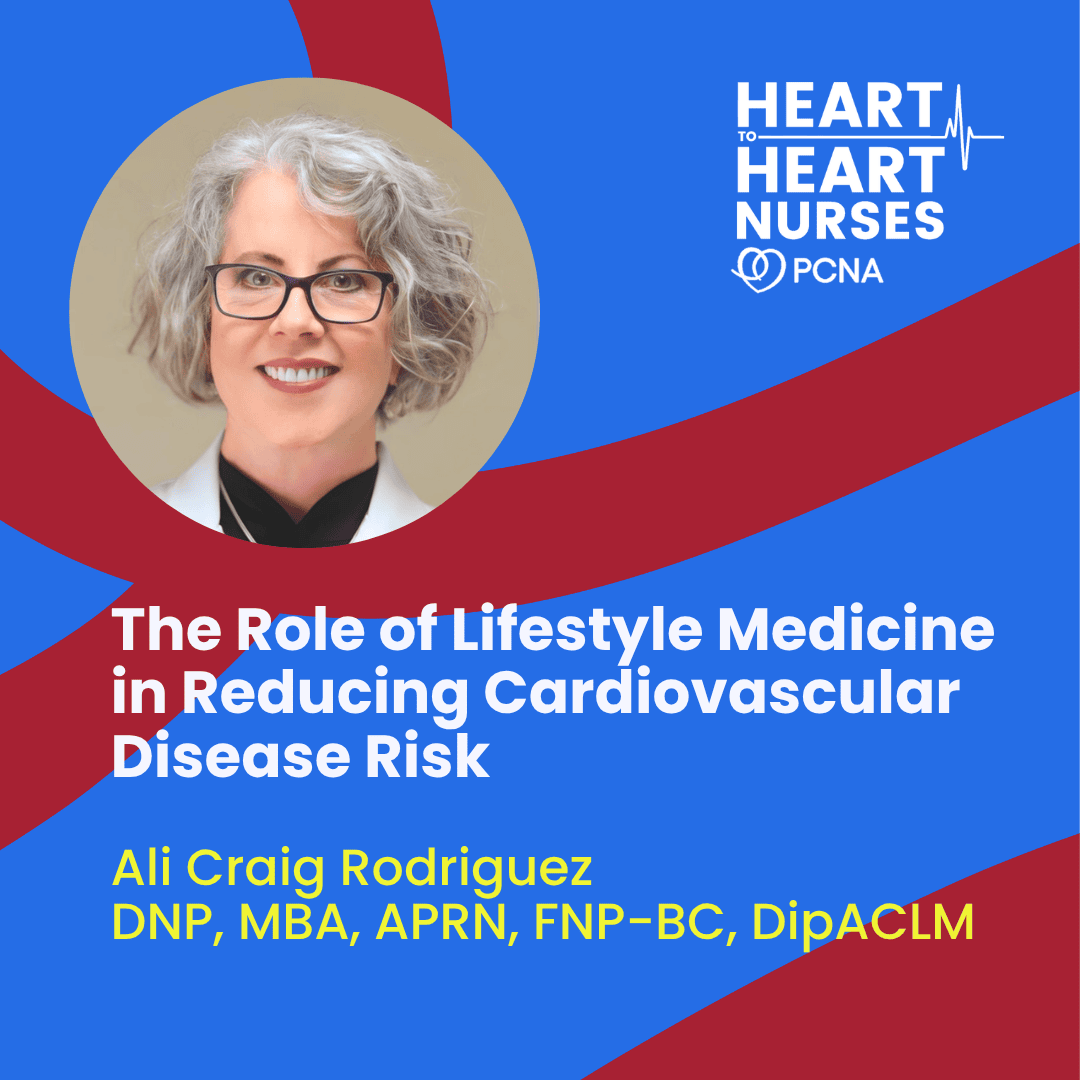
With lifestyle identified as the first intervention in guideline-directed therapy, applying the pillars of lifestyle medicine into practice can help prevent cardiovascular disease from happening in the first place. Guest Ali Craig Rodriguez, DNP, MBA, APRN, FNP-BC, DipACLM, describes the importance of partnering with patients to incorporate healthy behaviors to stave off or slow disease progression.
Episode Resources
‘m Yvonne Commodore-Mensah, Board President for PCNA. I’d like to welcome you to this episode of Heart to Heart Nurses. PCNA supports your professional journey with accessible continuing education, practical patient resources and a vibrant community that understands the unique challenges and rewards of cardiovascular nursing. Together, we’re advancing the knowledge that defines excellence in cardiac care while celebrating the difference you make every day.
Geralyn Warfield (host): (00:20)
Welcome to our audience where we’re having a conversation today with Ali Craig Rodriguez. And Ali, could you introduce yourself to us, please?
Ali Craig Rodriguez (guest): (00:26)
Yes, good morning, everyone. My name is Dr. Ali Craig Rodriguez. I am a clinical professor and a family nurse practitioner. I am teaching at Florida State University College of Nursing. Our program is the first in the nation to be recognized by the American College of Lifestyle Medicine as a full academic partner. So, I lead the Lifestyle Medicine program at Florida State University College of Nursing.
Geralyn Warfield (host):
We are so grateful to you for sharing your expertise with us today. And I’m wondering if you could address the first question, which is what, really, is lifestyle medicine for those of us that maybe don’t have a good sense of how that fits in.
Ali Craig Rodriguez (guest):
Well, lifestyle medicine is a branch of medicine or therapeutic specialty, if you will, that really looks at lifestyle interventions as a first-line treatment before other more invasive interventions, including medications. So, we look at all of those foundational pillars of lifestyle medicine.
So, nutrition is the first pillar.
Physical activity is the second pillar.
The third pillar is really getting good restorative sleep. Our sleep is our superpower.
We also look at stress mitigation. We are carrying so much stress in our bodies, and so we really work very hard to help to lower stress levels.
We also look at avoiding risky substances and behaviors.
And then the final pillar, very, very important, is positive social connections. We are hardwired to be social creatures, and so isolation really is the enemy of longevity.
Geralyn Warfield (host):
I so love all these pillars. And they really speak to our audience in terms of things that we’re trying to accomplish with our patients. And that last one in particular intrigues me the most, because as we all know the COVID pandemic really changed the way we interact with one another or don’t interact with one another.
I’m wondering if you have seen any research to demonstrate how that really has impacted us.
Ali Craig Rodriguez (guest):
Well, we know the pandemic is in our rear-view mirror, but we’ll never forget it. I think, in particular, the elderly were isolated for many, many months at a time.
And what the studies have now shown is that isolation is equivalent to smoking 15 cigarettes per day. So, it really can cut the lifespan short, just not being able to interact with other human beings.
And so, our ancestors were very much social creatures as well. We existed in tribes and that was really important for the procurement of food, for our safety. And so, we’re still wired that way.
And so when the pandemic came about, I don’t think we were prepared for that isolation. We tried our best to adapt, but from a physiologic standpoint, it really harmed many, many people.
Geralyn Warfield (host):
Well, I appreciate you taking a little extra time on that perspective because it has been, it seems like it’s been a long time ago. Sometimes it seems like it was yesterday, but it really has continuing impacts on health—and it definitely affected other pillars in terms of sleep, in terms of exercise. So, I think we are still all on recovery mode.
And, for those of us that are dealing with patients that have long COVID, there’s obviously some long-standing effects from all of that.
Ali Craig Rodriguez (guest):
I practice in a lifestyle medicine clinic. And we have quite a few patients who are suffering from what we call long COVID. So, although the pandemic is behind us, there have been very lasting physiologic effects from individuals who have experienced COVID.
Geralyn Warfield (host):
Well, again, thank you so much for taking a little extra time on that.
Could you share with our audience the kind of how traditional medicine and lifestyle medicine are complementary, or how they might be different?
Ali Craig Rodriguez (guest): (05:03)
Great question. I think the most important differentiator between lifestyle medicine and the current medical model is that in lifestyle medicine, we don’t wait for the disease to happen or the condition to happen. We look upstream.
Because if you think about it, we don’t wake up one day and lo and behold, we have diabetes or hypertension or Alzheimer’s disease. These are brewing years ahead. And so, if we can look upstream, rather than waiting for that diagnosis to occur, we can actually prevent that condition from even happening in the first place.
So, an example would be simple annual lab work. You look at a reference range, and that reference range, in some ways people think, “OK, as long as I’m in that range, I’m normal.”
But what that range really is, it’s a statistical norm. That’s where 95% of individuals in that age group, in that geographical region, fall. But it doesn’t mean that 95% of the population feel healthy and are thriving.
So, what we do is we look for early biomarkers. So rather than waiting, for example, for a hemoglobin A1C to tell us that you have diabetes, we look at fasting insulin. And that will actually give us a clue long before your hemoglobin A1C will ever be abnormal.
So, we really look very much ahead and we will treat from those markers. So, it’s very, very different than conventional medicine in that way. And if we can prevent that chronic condition from happening in the first place, then we’ve done our job.
And the other thing too is, if these lifestyle interventions, they’re very, very simple, but they’re so powerful, if we can help someone change their behavior from an unhealthy behavior to a healthy one, we can actually reverse chronic disease.
Geralyn Warfield (host): (07:20.554)
So, it sounds like there’s significant impacts from trying to actually access that information so much earlier. But it’s definitely a mindset shift for those of us that are in practice, isn’t it? To be more, even more preventive than we already are.
Ali Craig Rodriguez (guest):
Right. And if you look at any guideline, we’re talking hypertension guidelines, heart disease guidelines, rheumatologic disorder guidelines, every single one of those guidelines has lifestyle change as the first intervention. But I think as providers and healthcare providers, we actually think, okay, well, we’re going to need to just go right to the second intervention, which is medication.
What we have to do is put our patients in the driver’s seat. Because they will change their behavior if there is someone who is literally providing them with all of the tools to be successful. We can educate, but in the end, our patients have to make that change.
And so, if we can help them by giving them all of the tools to be successful, be that coach for them. So, we take off our expert hat, if you will, and we put on our coaching hat and we’re there to support them every step of the way.
So, one of the things that I share with my patients is I let them know that they are the CEO of their health and I am their chief motivational officer. So, they’re in the driver’s seat, I’m right there in the passenger side, giving them lots of support along the way, whatever it is that they need, tools to succeed, but they are the ones driving that vehicle.
And that really is a shift. It’s a paradigm shift. Because as patients, we’re used to getting instructions. We want to know, “All right, you’re the expert, tell me what I need to do.”
But ultimately, that works for a short period of time, but it doesn’t work long-term. So, if we can inspire, educate, and empower our patients to change their unhealthy behaviors, replacing them with healthy behaviors, that’s what lifestyle medicine is all about.
Geralyn Warfield (host):
Ali, thank you so much for that. We’re going to take a quick break, and we will be right back.
Geralyn Warfield (host):
We’re back talking about lifestyle medicine. And for our audience particularly, how does that fit into cardiovascular disease prevention?
Ali Craig Rodriguez (guest):
Oh, my goodness, it really fits in quite well.
If you think about it, Americans in particular are suffering from what I would describe is the potential for cardiometabolic disease. So, we used to call diabetes a separate disease, heart disease, separate. It’s actually one disease.
.
And what we’re learning from the evidence—and what really scares me the most—is that there are many who believe that our children will not have as long of a lifespan as their parents. And I think that has everything to do with diet, physical inactivity, ultra-processed foods.
And we’re learning that children are developing obesity at a very, very young age. Developing fatty liver disease in their 30s. And there’s a very good chance that this current younger generation will actually have cardiometabolic disease much, much earlier than we would ever imagine.
So, I think lifestyle medicine has a very, very important place in the cardiovascular realm. It’s very, very important that we pay attention to that.
Geralyn Warfield (host):
Well, thank you for that comprehensive overview of lifestyle medicine, how it fits in with cardiovascular disease prevention as well as management.
Do you have one key takeaway that you would like to leave with our audience?
Ali Craig Rodriguez (guest):
Well, I would say that lifestyle medicine is the medicine of the future. I think that we know that medications are life-saving. They’re very important. But really, they’re only one tool in the toolbox. And without lifestyle change, we don’t believe that an individual will really be thriving and will feel well. And so, whether it’s as an adjunct to medication, or to replace the medication. lifestyle medicine is very, very powerful.
Geralyn Warfield (host):
Thank you so very much for being here today, Ali. We are really grateful to you.
Ali Craig Rodriguez (guest): (12:19.408)
It was my pleasure. Thank you so much.
Geralyn Warfield (host):
This is Geralyn Warfield, your host, we will see you next time.
Thank you for joining us for this episode of Heart to Heart Nurses. We invite you to visit pcna.net for education and resources that will empower you to provide preventive cardiovascular care with confidence and expertise.
Published on
April 21, 2026
Listen on:
DNP, MBA, APRN, FNP-BC, DipACLM
Related Resources