






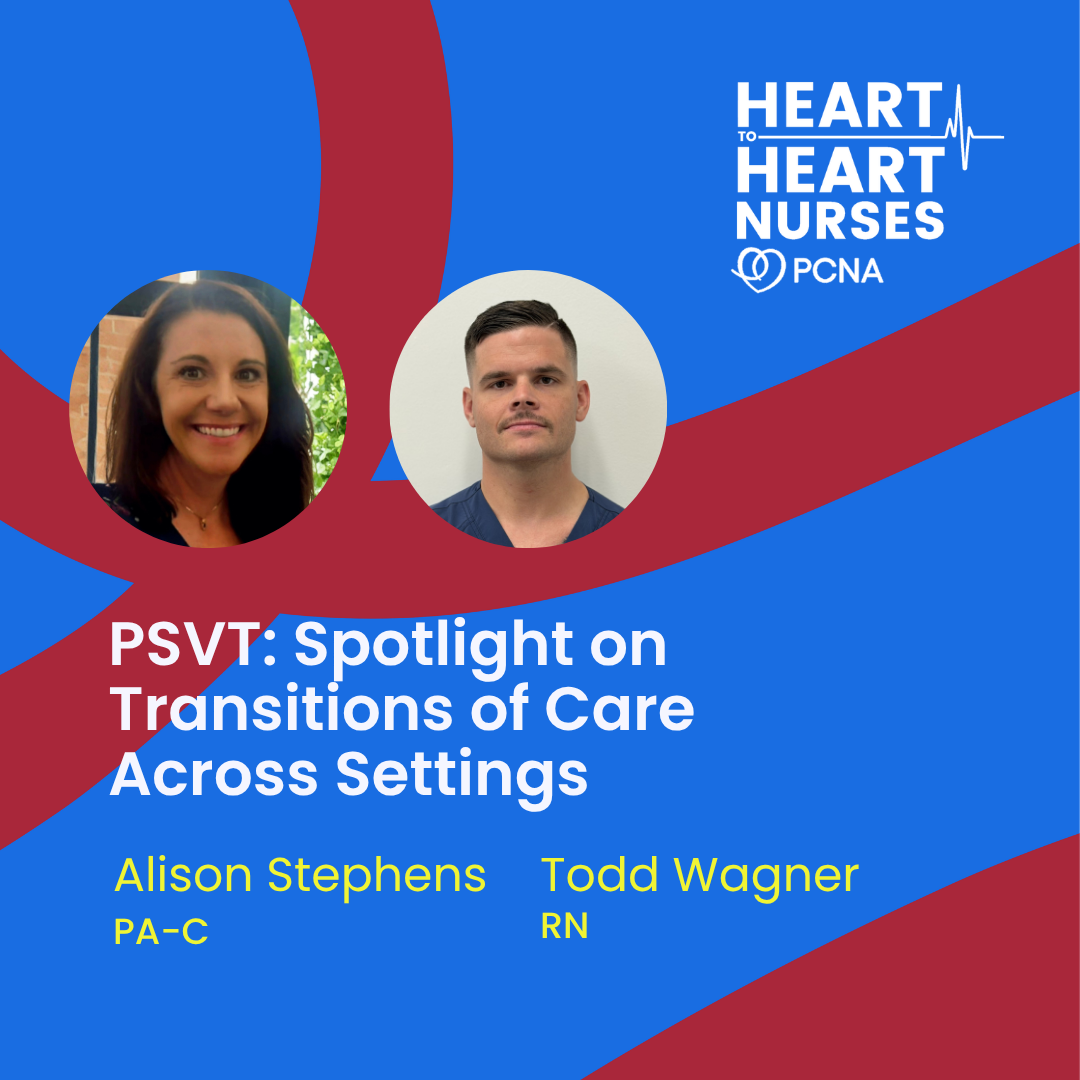
This podcast episode explores transitions of care for patients with PSVT (paroxysmal supraventricular tachycardia), featuring insights from Alison Stephens, PA-C and Todd Wagner, RN. They discuss diagnosis, treatment pathways and the importance of patient education, follow-up care, and addressing social determinants of health to prevent recurrence and improve outcomes.
0.5 CE contact hours are available for this episode through June 15, 2027. Access the CE through this corresponding course.
PCNA Resources
- Patient Journey: PSVT Strikes Anytime, Anyplace (video)
- PSVT: Barriers and Solutions to the Disease Burden for Patients (video)
- Living with PSVT: A Patient-Centered Care Plan (podcast)
- Living with PSVT: Episodic Rapid Heart Rates (podcast)
Thank you to Milestone Pharmaceuticals for their independent medical education support for this podcast episode.

CE units are available for this episode only through June 15, 2027. To access CE, visit pcna.net/course/spotlight-on-psvt/.
Geralyn Warfield, Host (00:31)
I’d like to welcome our audience to this episode that’s about PSVT, which is paroxysmal supraventricular tachycardia. So, I’m going to be calling that PSVT so I don’t trip over that name very much. And our previous episode in this miniseries looked at treatment options. Today we’re going to be exploring that next step in a patient’s journey, and that is transitions of care from one setting to another.
Today I’m joined by Alison Stephens and Todd Wagner, and I’m going to have them introduce themselves to you. Alison, could you start please?
Alison Stephens, Guest (01:01)
Sure. My name is Alison Stephens. I am a physician assistant. I have been a PA for 25 years this July. I’ve worked four years in emergency medicine at a level one trauma center and the last 19 in cardiology, with 17 of those focused in electrophysiology.
Geralyn Warfield, Host (01:22)
And Todd, how about you?
Todd Wagner, Guest (01:23)
My name’s Todd Wagner. I’ve been a registered nurse for over 15 years and 14 of those years have been spent in the emergency room. 10 of those 14 years in the leadership role.
Throughout my career, I’ve cared for many patients experiencing cardiovascular conditions, including PSVT. These experiences have definitely given me a valuable insight on the importance of recognition, prevention, patient education, and the effective management of it.
Geralyn Warfield, Host (01:53)
Well, thank you both again for joining us on today’s episode. And I’m sure our audience can tell already that we have some great experts at the table. I’d like to start our conversation today talking a little bit about what a typical patient presenting with PSVT in the emergency department, how they are treated. And Todd, based on your experience, could you start and then we’ll have Alison share her perspective.
Todd Wagner, Guest (02:16)
so the treatment approach for these patients with SVT depends largely on whether the if they’re hemodynamically stable or not. In stable patients we typically begin with like non-pharmaceutical, and less invasive things such as like vagal maneuvers. While simultaneously while we’re doing that, we’re getting IV access, getting the patient on the cardiac monitor, and the defibrillator pads.
If the vagal maneuvers that in the non-invasive side doesn’t work or are unsuccessful, we generally proceed to adenosine starting with six milligrams, rapid IV push, because the half life’s very short. If that doesn’t work, we’ll transition to twelve milligrams.
But in certain cases, which I’ve done it maybe twice in my career, where I’ve given an 18 milligram single dose when it was clinically appropriate and it was under the direct direction of the emergency physician as well as the cardiologist that knew the patient.
So, with for those patients who are hemodynamically unstable, particularly the ones that [have] significant hypotension and or just signs of poor perfusions, we may move directly to like synchronized cardioversion to restore normal cardiac rhythm as quickly and safely as possible. And it also brings up the point of providing like moderate sedation for those type of patients.
Alison Stephens, Guest (03:35)
Those were great points, Todd I also want to mention that SVT, while usually obvious on cardiac monitors, is best confirmed by an EKG, as well as patient history.
As Todd stated, and I gave a general overview in the first episode in this mini-series, the treatment pathway is usually fairly straightforward. SVT is commonly diagnosed in late teen, early twenties, usually in the emergency room.
When I was in the ER, I saw patients anywhere from ages 20 to 50s. Most times this patient population is fairly healthy with few other medical issues, and treatment in the emergency room is generally straightforward and easy and uncomplicated.
Geralyn Warfield, Host (04:22)
Alison, you also had mentioned that you now work in electrophysiology, and I’m hoping you could share a little bit more about your typical interactions with these patients with PSVT.
Alison Stephens, Guest (04:30)
Yeah, so usually in the initial evaluation I try to find confirmation of the diagnosis, usually with EKG. A lot of arrhythmias can present with similar symptoms but look very different on paper and can be treated very differently. So, I look for an EKG or a Holter monitor.
After reviewing symptoms, including the severity of the symptoms, how bad a patient feels and frequency is, and how often they have symptoms. I discuss with them treatment options, taking into account other medical issues. Cardiac issues, pulmonary issues, those types of things.
And unless a patient is very high risk for an ablation, which requires moderate sedation, so if they’re a high sedation risk, I will review an ablation procedure as usually the gold standard and first line treatment for this problem.
So, I go over the risk and benefit of the procedure as well as recovery after procedure. I’ve only had a handful of patients not utilize ablation treatment. And that usually is because of other compounding medical issues. Usually it’s a pulmonary issue, lung issues, that make sedation or anesthesia too high risk or other circumstances.
Specifically, heart failure, people with end stage heart failure or other types of cardiac processes that make sedation too risky. Patients with advanced dementia are sometimes not a great candidate or patients in palliative care for whatever reason may not have the best outcome from this type of treatment. But the high curative rate and low risk lead to a majority of patients choosing ablation option for treatment.
Geralyn Warfield, Host (06:16)
One important aspect of patient centered care is really recognizing and appreciating the patient experience. Todd, as we think about patients who are having PSVT, having an episode, and they’re being rushed to the ED, can you give us some examples of what that looks like for them?
Todd Wagner, Guest (06:35)
So I mean, in most cases when these patients come like present in the ED, they report palpitations, a feeling of anxiety, and in some patients will have chest discomfort and dizziness and like almost like a feeling of impending doom. But really that’s all just triggered by the rapid heart rate that they’re dealing with and the decreased cardiac output.
Geralyn Warfield, Host (06:57)
It seems like these patients might be in and out of the ED quite a bit, and I’m wondering how clinicians can best manage these patients across different care settings, because those transitions really are quite critical in making sure their treatment is successful. Todd, could you maybe address that for us?
Todd Wagner, Guest (07:14)
I believe one of the most important aspects of caring for these patients with SVT is just ensuring that smooth transition home from the emergency department. But before discharge, we obviously want to make sure that the patient symptoms have resolved and any abnormal diagnostic labs are addressed. But as nurses we need to ensure that they understand what their diagnosis is.
And that’s where patient education is a key component of that transition.
We discuss potential triggers like signs and symptoms to watch for and when they should seek immediate medical attention. We also review any medication changes and make sure that they understand how and when they take their medications.
Equally important is arranging appropriate follow-up care. Many patients will need follow-up with a primary care physician and often a cardiologist, particularly if this is a new diagnosis or a recurring issue. Some patients may require additional outpatient testing, such as heart monitoring or future or further cardiac evaluation.
As nurses, we play a critical role in bridging the gap between the emergency department and outpatient setting by providing education, reinforcing the discharge instructions by the physician, and helping patients feel confident in managing their condition after they leave the hospital.
But ultimately our goal is to reduce repeat emergency visits and improve long-term quality of life for these patients.
Alison Stephens, Guest (08:39)
I couldn’t agree more, Todd. I also want to add that during a clinic visit when I see patients, I also instruct them to return to the emergency room for recurrent symptoms of SVT or PSVT that does not resolve with maneuvers that they’re instructed to use at home, like the vagal maneuvers.
Simply because recurrent episodes that do not resolve can lead patients hemodynamically compromised and ongoing episodes or recurrent long episodes can lead to a tachycardia induced cardiomyopathy where the muscle gets weakened. Then we are dealing with a whole set of other problems.
And [in] EP, we like to get these patients in ASAP when they’ve had their first presentation to the ER or to some provider where this is documented. It’s important to get this treated as quickly as possible.
Geralyn Warfield, Host (09:31)
We have been discussing PSVT and the experience of patients as they enter and leave the ER. We are going to take a quick break, and we will be right back.
We’d like to welcome our audience back to our discussion of PSVT, and we’re grateful to Alison and Todd to be here for this discussion. So far, we’ve explored the traditional PSVT patients that we see and how they can best be managed across different care settings.
I’m wondering Alison if you could start us off talking about best practices when it comes to serving patients of all backgrounds and keeping in mind specifically social determinants of health.
Alison Stephens, Guest (10:06)
Yeah, as a provider, I do have to be mindful of barriers and needs of patients. I do provide patients with a patient handout that our facility generates that’s sort of in non-medical terms; as to the cause of SVT treatment options, specifically ablation, risk, benefits, and then also recovery. I hand this out to patients and their family if they’re there at the appointment. I encourage them to read it, review it, and call with questions so we can go over all that information prior to the procedure.
Upon discussing the details of procedure, patients will need transportation on that day because they do get anesthesia. Most times patients can be discharged home the same day. Sometimes there’s reasons to keep them for observation. If patients don’t have transportation, I work with social work to get that arranged, or there’ll be a social admit to the hospital. Obviously, this scenario adds an extra cost to patients if they have to have a stay in the hospital that’s not typical, especially if their health care coverage is very minimal or they have a high deductible.
So, I utilize the knowledge and resources of our social workers, nurses who always seem to have more knowledge of those other things than I do, to help with the non-specific provider care or medical aspects that we can address, and we’re planned and ready for those circumstances.
Todd Wagner, Guest (11:33)
Yeah, I really want to, you know, echo what Alison stated and add that, when caring for these patients from all backgrounds, it’s just super important to recognize that not everyone has the same access to healthcare resources. Many patients face barriers that can affect their ability to manage their health, such as I mean, as you were talking about, the lack of transportation, as Alison stated, and the financial challenges, difficulty affording medications, the lack of established healthcare providers, and just overall low health literacy.
But as nurses, it’s our responsibility to identify these barriers and help connect these patients to resources that can support their care.
It also helps getting case management involved because sometimes I don’t know all the new updated resources and they’re just a plethora of knowledge to tap into in the emergency department.
But it’s also important to make sure that these patients just understand their diagnosis, their treatment plan, and then making sure that they understand that they need to follow up with their cardiologists and do it promptly.
But it really is important that we as nurses, take the time sitting at eye level and just listening to the patient and getting the family involved is a very crucial step in the whole process just to get a better understanding of what they need or what they understand.
But just by taking time to understand each patient’s individual circumstances, we can provide just more effective care and help reduce gaps in healthcare. But addressing those social determinants of health isn’t just about treating a disease, it’s about helping patients overcome the challenges that may prevent them from achieving the best possible outcome and the overall quality of life.
Geralyn Warfield, Host (13:14)
Could you please speak to the impact that caring for these patients that are experienced a first or recurrent PSVT episode, how that affects the ED’s resources and workflow?
Specifically, how does this impact staffing, monitoring requirements, treatment resources, and even overall department operations? And Todd, maybe you could start us off.
Todd Wagner, Guest (13:38)
So, with a patient coming in with SVT, it does require a lot of attention and resources in the emergency department. Some of them including just the basic cardiac monitoring, the medications, like close one-to-one nursing care, and requires hours of observation post conversion. These cases just take up valuable time and bed space, especially during very busy shifts.
That’s why early treatment, patient education, proper follow up is just so important. They help improve outcomes and they may reduce future visits to the emergency department.
Alison Stephens, Guest (14:17)
Yeah, I agree with Todd. Many resources are used for treatment of SVT, even in the most straightforward of cases in a young, healthy person.
Additionally, another concern, especially for immunocompromised patients who have PSVT, needing medical care in the height of flu season or in a circumstance like COVID, risk of exposure to an illness, in the emergency room or that type of setting is much higher for those patients.
So, if contracted, you know, those illnesses could be detrimental to this group. So, they come in trying to get treatment for their PSVT and end up getting very, very ill by sitting in the waiting room or being in contact with everyone else in the ER.
Geralyn Warfield, Host (14:59)
Before we wrap up this episode, could you give our audience one key takeaway from our discussion today?
Todd Wagner, Guest (15:06)
If there’s one key takeaway from our discussion today, it’s the successful cardiovascular care goes beyond treating a patient’s symptoms in the moment.
It requires education, prevention, and just understanding the barriers that patients may face once they leave the healthcare setting. But by empowering the patients with knowledge and connecting them to the resources they need, we can help improve long-term health care, heart health, and just reduce overall future complications.
Alison Stephens, Guest (15:35)
Exactly. Patient patient-centered care involves more than treatment. As Todd said, involves educating patients and families, encouraging patients to be their own advocate and involved in their care is also important. Making sure to have open-ended conversations with patients and families to ensure their needs are met, medical, social, etc. Creating an environment where this occurs is best as a multi-professional task, which includes providers, RNs, social workers working together to have you know successful patient outcomes.
Geralyn Warfield, Host (16:11)
We are so incredibly grateful to our guests Alison Stephens and Todd Wagner for being here on our episode today.
We’d also like to thank Milestone Pharmaceuticals for their unrestricted grant funding for this episode and this miniseries. This is your host, Geralyn Warfield, and we will see you next time.
Topics
- Arrhythmias
Published on
September 15, 2026
Listen on:
PA-C
RN
Related Resources

Online Interactive Guides
The Beat Goes On: Living with Atrial Fibrillation Online Interactive Patient Guide
July 30, 2025