





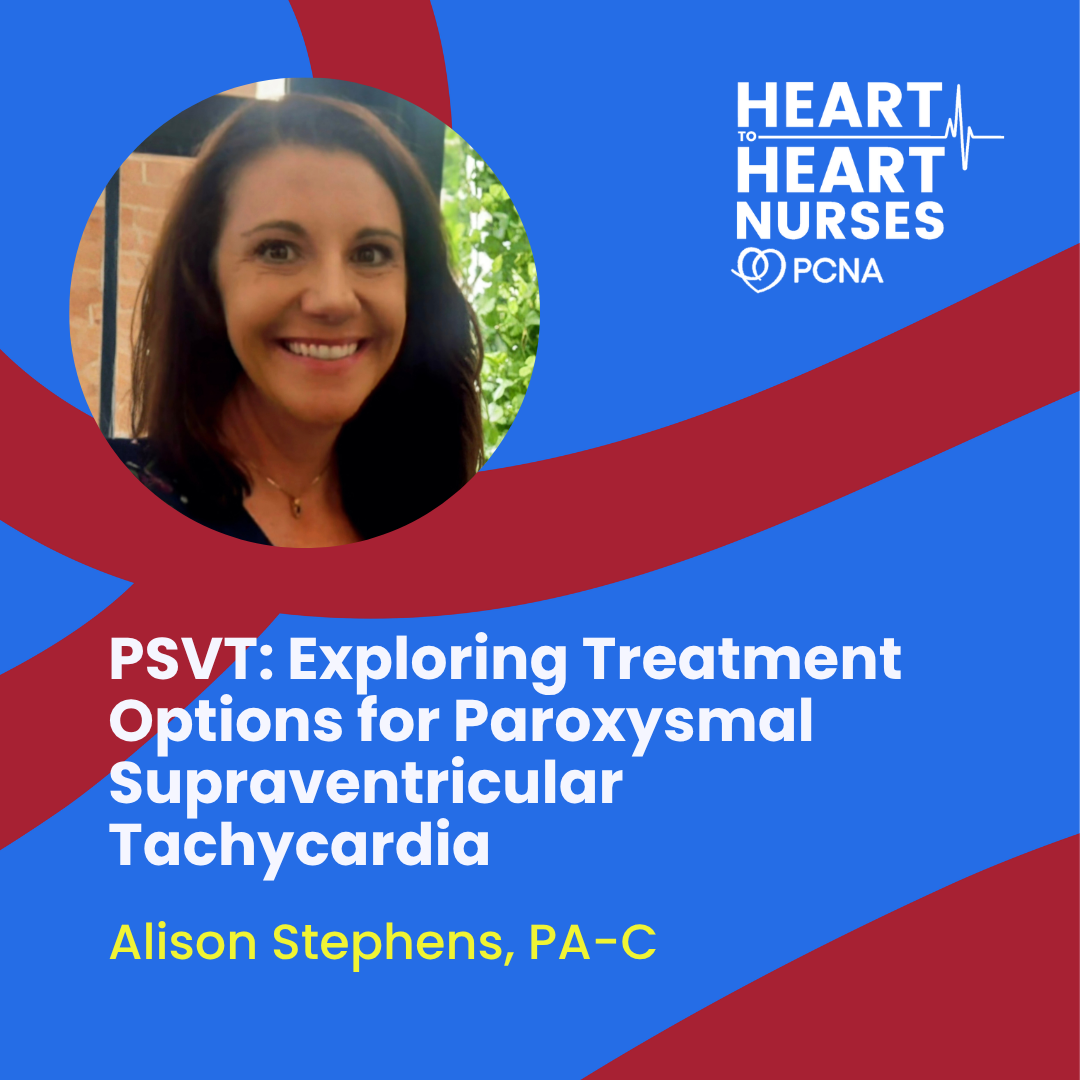
Join Alison Stephens, PA-C, as she defines PSVT (paroxysmal supraventricular tachycardia), explores its impact on patients’ quality of life, and discusses various treatment options, including a new FDA-approved nasal spray.
0.5 CE contact hours are available for this episode through June 15, 2027. Access the CE through this corresponding course.
PCNA Resources
- Patient Journey: PSVT Strikes Anytime, Anyplace (video)
- PSVT: Barriers and Solutions to the Disease Burden for Patients (video)
- Living with PSVT: A Patient-Centered Care Plan (podcast)
- Living with PSVT: Episodic Rapid Heart Rates (podcast)
Episode Resources
- Self-Administered Etripamil and Emergency Department Visits in Supraventricular Tachycardia(opens in new tab)
- Self-administered intranasal etripamil using a symptom-prompted, repeat-dose regimen for atrioventricular-nodal-dependent supraventricular tachycardia (RAPID): a multicentre, randomized trial(opens in new tab)
- Catheter Ablation of Atypical Atrioventricular Nodal Reentrant Tachycardia(opens in new tab)
Thank you to Milestone Pharmaceuticals for their independent medical education support for this podcast episode.
CE units are available for this episode only through June 15, 2027. To access CE, visit pcna.net/course/spotlight-on-psvt/.
Geralyn Warfield (host): (00:31)
Welcome to our audience to today’s episode, the first in a two-episode mini-series about PSVT, otherwise known as paroxysmal supraventricular tachycardia. Today we’re going to explore treatment options for PSVT, and we have a great guest here to help describe what that is. Alison Stephens, could you please introduce yourself to our audience?
Alison Stephens (Guest): (00:51)
Sure. Hi, my name is Alison Stephens. I am a physician assistant. I have been a PA for twenty-five years. I worked four years in emergency medicine at a level one trauma center and the last 19 years in cardiology, with 17 of those focused in electrophysiology.
Geralyn Warfield (host): (01:09)
Well, thank you so very much for being here. I’m sure our audience can tell already how experienced you are with our topic for today. And let’s start with a level-set question, and that is what is PSVT?
Alison Stephens (Guest): (01:21)
SVT or PSVT is an abnormal heart rhythm in which people are born with an extra cardiac circuit that causes the heart to beat very fast. These episodes can last seconds or up to several minutes.
The intermittent episodes, also known as paroxysmal, which is the P in the PSVT; symptoms include heart, racing heart, palpitations, chest pain, or dizziness. These symptoms, when severe enough or long enough, will cause patients to seek medical attention.
Geralyn Warfield (host): (02:00)
Thanks so very much for clarifying that SVT and PSVT sometimes are used interchangeably. And these episodes sound like they might be pretty darn frightening for patients because they’re unpredictable and you might not, you know, you have no idea how long these are going to last. So how does this diagnosis of PSVT impact the quality of life for patients that get that?
Alison Stephens (Guest): (02:20)
SVT episodes do not come with a warning or a specific trigger, usually. They can happen at any time. So, the anticipation of a recurrent event certainly can be cause for daily worry or a lot of anxiety. Usually, a patient’s symptoms are similar each time, but not always. New or slightly different symptoms can also elicit extra concern for the patient.
These episodes also have impact on families as well, if patients need to seek emergency care. For those who do not work in emergency room care or not familiar with hospital care in general, ER visits can be overwhelming.
Geralyn Warfield (host): (03:02)
And what do the current treatments look like for PSVT patients?
Alison Stephens (Guest): (03:07)
So once SVT is confirmed, patients are often encouraged to try a vagal maneuver, which is bearing down, like you’re having a bowel movement. Other non-pharmacologic options include carotid massage or placing your face in ice water, both of which also trigger a vagal response.
In the emergency room setting, adenosine is often used in IV form for chemical cardioversion. If unsuccessful after multiple attempts and dosing, or if a patient is unstable, a direct current cardioversion can be performed.
In outpatient setting follow-up, medications such as metoprolol or diltiazem can be used to help control the heart rate if and when an SVT episode occurs. These medications can be helpful, but they do not prevent episodes from occurring.
A curative treatment is an ablation. While this procedure is invasive, with the development of new ablation technology, the procedure is fairly low risk with a very high success rate, up to 98% lifetime. On occasion, patients will require a second ablation. I have only seen this occur in less than five patients over my career. Also, with new ablation technology, patients are able to be discharged home the same day.
Geralyn Warfield (host): (04:32)
We’ve been talking with Alison about treatment options for PSVT, and we are going to take a quick break and be right back.
We’re back speaking with Alison about treatment options for PSVT, and I’d like for us to spend our next part of this episode talking a little bit about what future PSVT options might look like.
Alison Stephens (Guest): (04:52)
There is a fairly new drug approved by the FDA. It’s a nasal spray for SVT. It’s entripamil or Cardamyst™, which is the trade name. The dose is two sprays at the onset of symptoms. The RAPID trial evaluated 692 patients with SVT. Sixty-four percent of patients had returned to normal heart rhythm within 30 minutes of use, compared to 31% in the placebo group.
Each bottle is one dose. If symptoms persist and additional dose is needed, a new bottle will need to be utilized. This is a valuable option for people who may live far from an emergency room.
As I mentioned earlier, ablation technology has improved such that the risk benefit for most patients is very acceptable. Accuracy, safety, and the ability to now be an outpatient procedure, as well as the extremely high success rate of ablation. This treatment option is offered most of the time to patients.
In studies published in PubMed, 100% of patients randomly assigned to ablation treatment remained free from recurrent SVT over five years compared to only 25% assigned to medication treatment. While ablation therapy is safe and effective, not every patient is a candidate or choose ablation. While medications can help suppress or treat symptoms, there is no medication that is preventative.
Geralyn Warfield (host): (06:57)
So before we wrap up this episode, I’m wondering if you could identify for us a key takeaway for our audience.
Alison Stephens (Guest): (07:03)
Sure. Listen to the patient history. SVT generally has a similar presentation or symptoms across patient populations. If SVT is documented on EKG or cardiac monitor, referral to cardiology should be the next step in patient care.
In the time patient may be willing to see specialists, patients and families should be educated on recognizing symptoms, valsalva maneuvers, and then when to seek emergency care is also a vital part of all this.
Geralyn Warfield (host): (07:36)
Thank you so much, Alison, for being here today and describing for us the treatment options for PSVT or SVT. We are so grateful to you for your time and for your expertise. We’d also
Alison Stephens (Guest): (07:46)
Thank you.
Geralyn Warfield (host): (07:47)
I would like to thank Milestone Pharmaceuticals for their unrestricted grant funding for this episode and this miniseries. This is your host, Geralyn Warfield, and we will see you next time.
Topics
- Arrhythmias
Published on
September 15, 2026
Listen on:
PA-C
Related Resources