






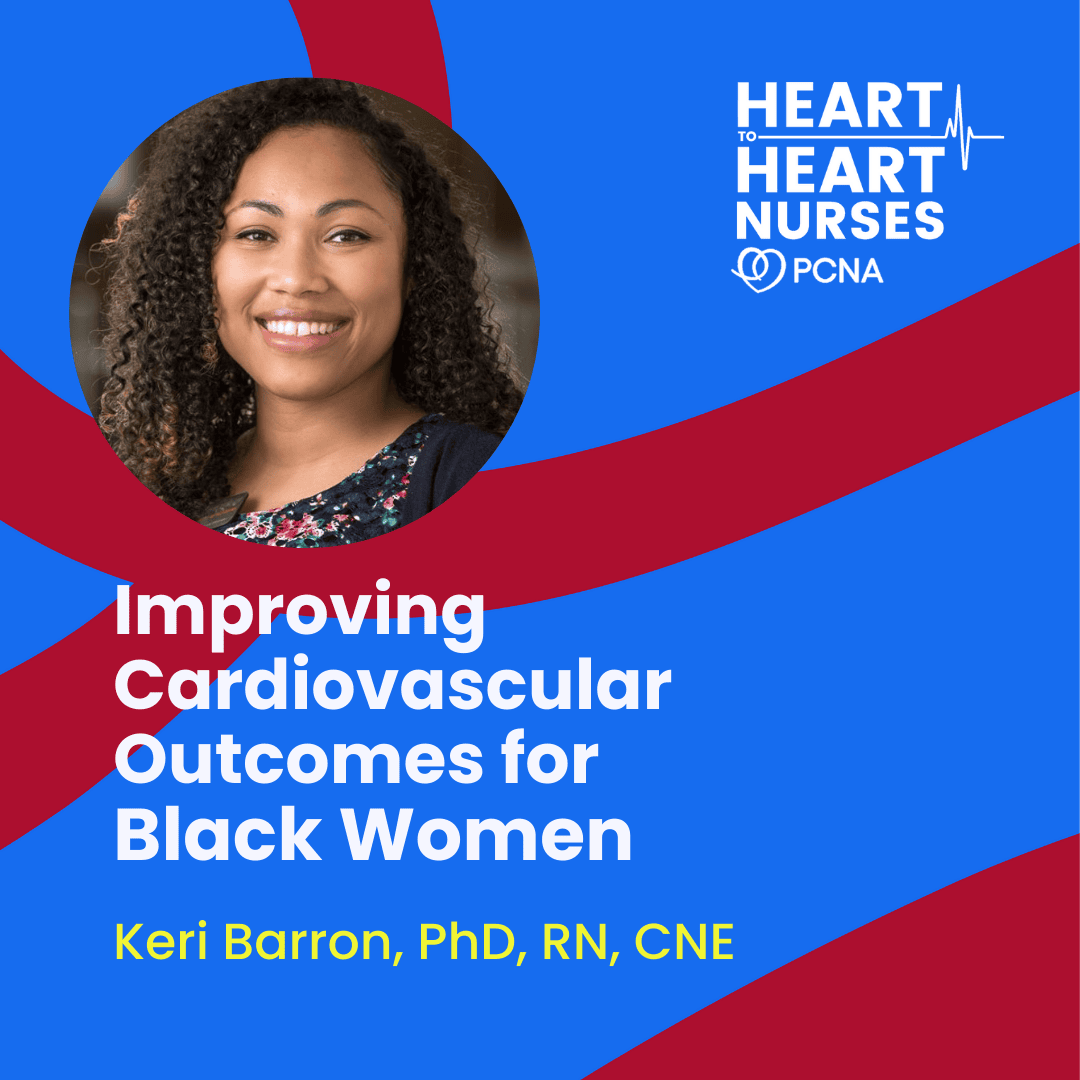
Guest Keri Barron, PhD, RN, CNE, shares ideas for improving cardiovascular outcomes for Black women. This includes individual actions such as preparation for clinical encounters and self-advocacy, as well as larger-scale initiatives like research and community outreach.
Episode Resources and References
- Churches as Cornerstones of Cardiovascular Health Promotion.
- Understanding the Essentials: Cardiovascular Nurses in Community Outreach
- Cushman M, Shay CM, Howard VJ, et al. G10-Year Differences in Women’s Awareness Related to Coronary Heart Disease. Circulation. 2020. DOI: 10.1161/CIR.0000000000000907.
Keri Barron podcast episode transcript
[00:00:00] I’m Erin Ferranti, board president for PCNA, and I’d like to welcome you to this episode of the Heart to Heart Nurses Podcast. PCNA is the proud home of cardiovascular nurses and one of the leading figures in the fight against cardiovascular disease. We have the resources you need for your day-to-day practice or to follow your passion to new areas of learning and growth.
Geralyn Warfield (host): 00:12)
I’d like to welcome our guest to today’s episode where we are speaking with Keri Barron. Keri, could you introduce yourself to our audience?
Keri Barron (guest): (00:26)
I am Keri Baron. I am an assistant professor at the University of Alabama, Capstone College of Nursing.
Geralyn Warfield (host): (00:32)
And today we’re going to talk a little bit about research. And I’m hoping you can get us started talking a little bit about what your journey has been like to get where you are today.
Keri Barron (guest): (00:42)
So originally, I am from Mississippi and transplanted to Alabama in 2017. But going through my doctoral program at the time I was working as a case manager, so that encouraged my dissertation which focused on reducing heart failure readmissions into our hospital because we were having issues with that at the time.
And so, in doing that, of course,
You know, you have to show you can do the work. So, successfully did that. But then when I was hired at the University of Alabama and I was working on my scholarly trajectory, I realized that my passions did not align with continuing the focus on heart failure readmissions. Not that it’s not important, because it is, but when you’re thinking about long-term tenure track professor, you want something that’s going to drive you. And so that’s when I made the transition to not focus on heart failure, but more so the prevention and management of heart disease.
At that time, my focus was underserved populations. And then across the years, I have niched down into Black women.
Geralyn Warfield (host): (02:02)
And so how is it that you’ve been able to make these transitions? What’s allowed you to change your focus of study through the years?
Keri Barron (guest): (02:11)
More so the research, the data. Just continuing to see how when we’re looking at the statistics about cardiovascular disease, I’m continuing to see how Black women are not on the receiving end of those good health outcomes. They’re top when it comes to hypertension, they’re top—and I’m saying ‘they,’ but ‘we,’ because I’m a Black woman—top when it comes to coronary artery disease, all those different classifications of cardiovascular disease, they’re at the top.
But then when you also look into the research, I continue to see the barriers that prevent us from advancing with heart disease research in Black women, such as lack of transportation, mistrust with the healthcare system, caregiving responsibility, those things. And so, that continues to drive me, my research, and that’s what helped to transition my scholarly trajectory.
Geralyn Warfield (host): (03:18)
So, we understand from a research perspective that women just in general are at higher risk. We typically do not pay attention to our symptoms. We are too busy. We are caregiving as you talked about. There’s all of kind of those issues that generally have caused us to suffer events when we do that unnecessarily if we were just paying attention to symptoms, taking care of ourselves, and those kinds of things.
But I’m really interested in your research in terms of those additional barriers that you’ve described for Black women. And I think that as people that are taking care of people, as nurses, we have some responsibility to be cognizant of that. And so, what kind of things could you tell our audience about things to look out for, things to ask, ways to ask questions that might be received in a more friendly manner perhaps, as we are trying to overcome some of those barriers that are long-standing, like that mistrust of the healthcare system.
Keri Barron (guest): (04:16)
One thing I think we have to consider, and this is just coming from my own personal experience in helping my grandmother whenever she’s going to the doctor or even my sisters. As a nurse, I know what to ask for, know what to say, so I am able to encourage them in that way to follow up and ask questions. As my grandmother says, just ask.
Sometimes you really don’t know what to ask. And so, providing on the healthcare side, and I know with insurance time is limited, but providing them with an opportunity to ask additional questions.
One thing that in some community engagement opportunities that I participated in with some older adults, I encouraged them to keep a notebook with them, write down their questions because time will be limited once you get into that clinic or that whatever healthcare setting that may be. So, if you have those questions written down, once that healthcare provider gets in there, you can go ahead and ask them those questions.
What they need to be, I guess in a healthcare system, be aware of is the importance of education and what that looks like for the different populations of people they are taking care of. Because when we’re looking at a lot of the literature that is provided to patients with any form of cardiovascular disease, it can be a lot. And a lot of times, when they receive that information, it’s going to be put to the side when they get home.
So, this is a great opportunity to work on translating, transforming the educational resources. We have AI. We have other innovative technologies out there that we can utilize to help our patient populations get a better understanding of their disease process.
Geralyn Warfield (host): (06:18)
I loved a couple of things that you said. I loved everything that you said, but I wanted to reiterate two things. And one is that writing down of those questions and encouraging patients to do that even as clinicians.
And prioritizing those. Because I have been with a family member who’s been needing care, been in to see the cardiologist and had a list of let’s say 12 different things they wanted to talk about. And the cardiologist finally said, “You know, our time is up” basically. Making sure that you talk about those most important things first.
But I think the other thing is, for patients and their family members ,and their caregivers, to help just like you: advocate for your family to advocate for themselves or those others that they’re with because otherwise some people just don’t feel comfortable. Or even in this case, there’s not enough time so what’s our next steps to ask the clinician. “I still have some questions. May I speak to the nurse about that?” or, “How would I go about doing ? Should we talk about this at my next visit?” Those kinds of things.
So, there’s a lot going on in any visit, just lots of complexity. I appreciate the fact that writing things down. And I don’t know about you, but I forget sometimes. My life’s kind of busy, and I get out of the office and go, “I really wish I had talked about this other thing as well.”
Keri Barron (guest): (07:29)
Yes, another thing I would like to add to is that it depends on your health care provider and whether or not you can have someone on the phone. So that’s something you can ask as well Just in case you may be forgetful of something you can ask. “Is it okay,” especially for an elderly Individual, “Is it okay for me to have my granddaughter/grandson/daughter on the phone on speaker so that she can hear and capture what you’re saying?”
Because they may forget what the health care provider said in that, you know, because they do feel overwhelmed sometimes in that particular setting. So, I wanted to add that too.
Geralyn Warfield (host): (08:08)
That’s an excellent suggestion. Thanks for sharing that, Keri. We’re going to take a quick break, and we will be right back.
Geralyn Warfield (host): We’re back talking with Keri Barron about health issues, particularly those in Black women. And I know one of your passions is the community connection for those individuals. Could you speak a little bit more about that?
Keri Barron (guest): (08:25)
Yes. So first, let me go back to, in regards to my research. So right now, one of my primary goals is to get a better understanding on how we can bridge the gap between the knowledge of heart disease and helping our, especially younger, Black women to get a better understanding. There’s a significant deficit there.
There are research studies—I know one I tend to go back to is the one by Cushman.
I can’t remember all of the other authors, but thank you to them as well. It was, I believe, published in 2020 and it highlighted the decline in awareness about heart disease being the number one cause of death in women, especially among younger Black women and Hispanic women. Like there was a decline there.
And so, my question that I’m always or often trying to understand is, how can we bridge that gap?
We have great programs, nationally recognized programs: Go Red for Women, great platform, they have different networks with organizations, but there still seems to be some type issue as to we are still not bridging that gap with our younger women. And what can we do to bridge that gap?
And so, one thing I am considering is the community connection. I feel like, as an academic, a lot of times, when it comes to dissemination, we tend to focus on those traditional methods such as manuscript publications, conferences, additional grant applications.
But then my concern is, are we bringing it back to the community? Not that those avenues are not important, but when we’re thinking about the people who are truly impacted, they’re not attending the conferences. They are not reading the manuscripts. And they may be a part of the grants—to help us get them—but we still should go back into the community.
So, I feel like the community connection is a way to help bridge that gap in talking to these women and getting a better understanding of where they live, where they work, where they play, right?
And so, one of my mentors and I on the study that we were talking about, maybe a year or so ago, we were talking about where women, younger Black women live, what are they doing? And one of the things we considered was going to football games, you know, where these women have their children participate in sports.
I, myself, have a teenage son, so I am familiar with sitting outside of practice and waiting for practice to be over. So that’s an opportune time to have a brief conversation, but we have to understand it may not always be in the traditional way in which information is disseminated.
Another thing to consider in regards to community is that social media is a community for a lot of young adults. Are we truly utilizing that to share the information that needs to be shared about heart disease?
Another way we can look at community is through storytelling. So, bringing women together who have had similar experiences, because sometimes it can, I would imagine…well, I don’t have any issues with heart disease at the moment.
I can say that, just from personal experience, my sister who had my nephew a couple of weeks ago, she is experiencing postpartum high blood pressure, which is crazy because she didn’t have it prior to pregnancy, during pregnancy, but at the end she had it. And I was her resource, and my mother was her resource because we both have medical backgrounds, but I’m sure it is a lonely feeling to be introduced to this new disease you know nothing about and trying to navigate that.
So having that opportunity to commune with women with similar backgrounds and similar disease processes, that’s one way to, through community, I feel like we can bridge that gap.
Geralyn Warfield (host): (12:57)
Your suggestions are very timely as we look to try and reach individuals where we haven’t seen them before. You are right that we have done manuscripts, we have even gone to places like barber shops or beauty salons, all great places to reach people, but looking to new ways to try and disseminate this information so that we can help individuals at a younger and younger age recognize what the risk factors are and so that we can address those at an earlier time so it does not become an issue.
And, you are right, pregnancy, as one of our other guests on one of our podcast episodes says, is a stress test. So, there are a lot of changes, and especially as a new parent, all the attention is focused on the child and now making sure that the mother also has that ongoing attention and helps to address those issues. So I love that sense of community.
Is there one key takeaway from our conversation that you would like to leave with our audience?
Keri Barron (guest): (13:54)
I think one key takeaway for me, I keep going back to personal, is to when conducting research, this is for the nurse scientist, is to remember your why. A lot of times I reflect upon that when working on manuscripts, when applying for additional grants, because you know that’s the world of academics.
But remember your why.
And then another thing is, like I mentioned previously, is this is an opportune time to be innovative. So, the traditional ways that we have done things, they’re great, but there are so many resources out there for us to further advance. So, remember your why.
And as my little [PCNA Cardiovascular Nursing Symposium] name tag says, so weird Be weird and figure out new ways just to disseminate our research.
Geralyn Warfield (host): (14:59)
Keri, thank you so very much for sharing your passion for the community, and particularly for Black women, with us. Your research has been very important to us in terms of learning more and I know it will continue to contribute to all that we say and do in the clinic setting. So, thank you so very much for doing that.
Keri Barron (guest): (15:17)
Thank you for the opportunity. Thank you.
Geralyn Warfield (host):
This is Geralyn Warfield, your host, and we will see you next time.
Thank you for listening to Heart to Heart Nurses. Visit PCNA.net for clinical resources, continuing education, and much more.
Topics
- Health Equity
- Women and Heart Disease
Published on
January 6, 2026
Listen on:
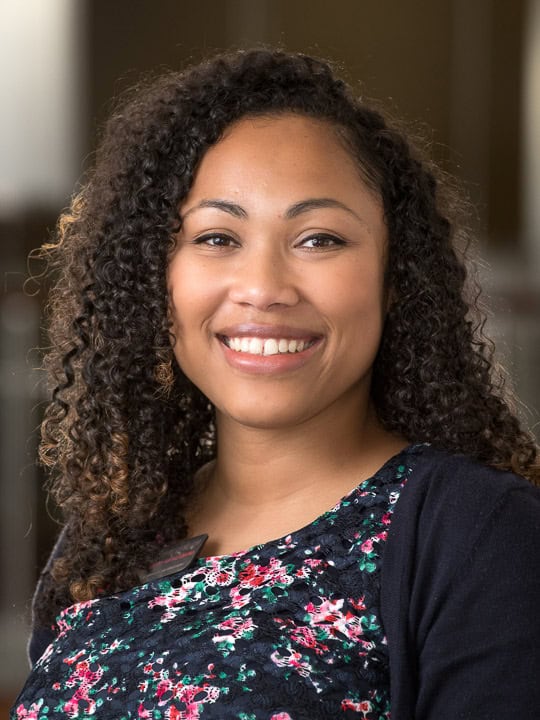
PhD, RN, CNE
Related Resources