







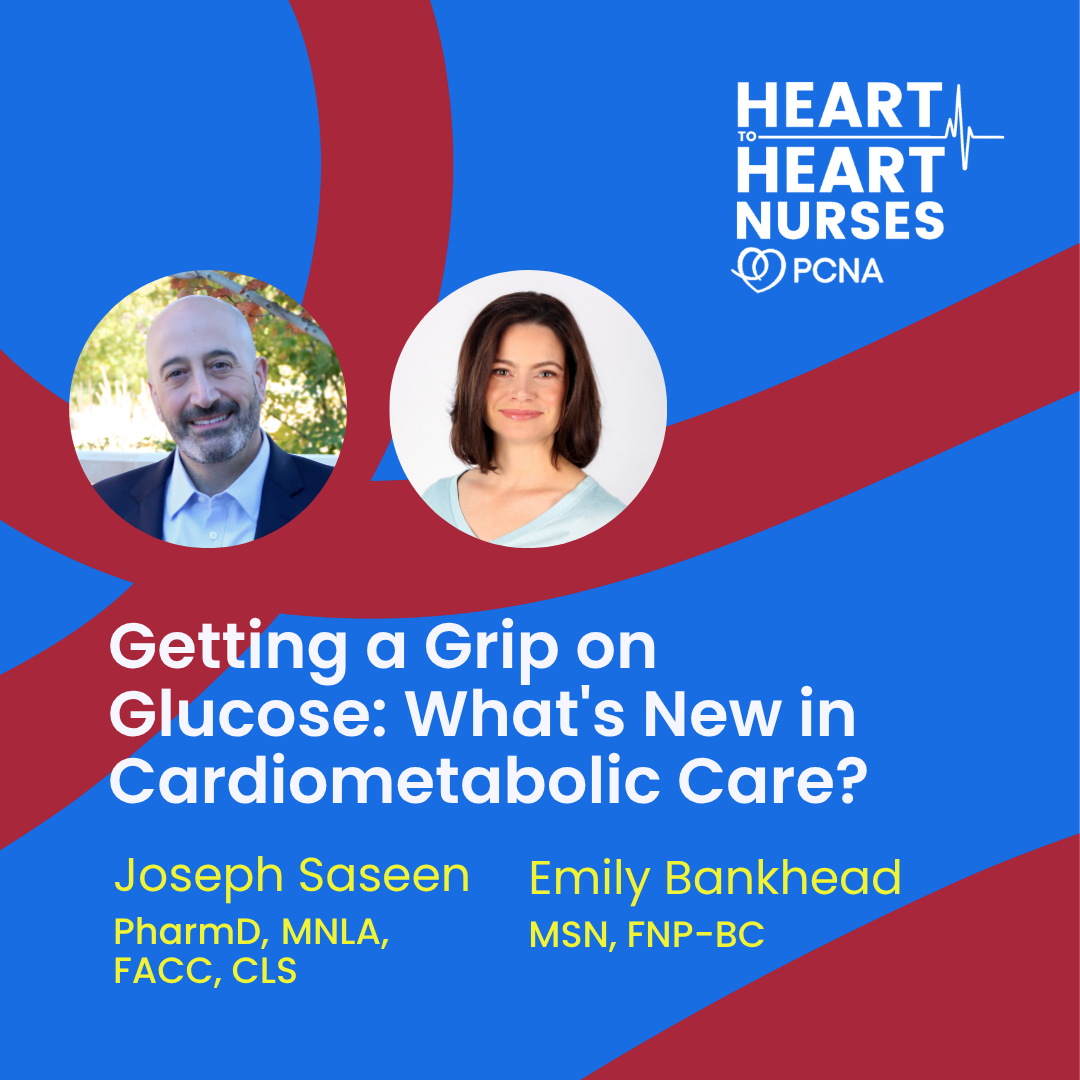
How can nurses and other healthcare professionals help patients with diabetes and other cardiometabolic conditions reduce their risk of CVD? Join guests Joseph Saseen, PharmD, MNLA, FACC, CLS, and Emily Bankhead, MSN, FNP-BC, for a discussion about applying current guidelines for hypertension and glucose-lowering therapies and the importance of team-based care.
Episode Resources
- 2025 AHA/ACC High Pressure Guideline
- 2026 Multi-Society CKM Guideline
- PREVENT Equations
- PCNA CE Course: Cardiometabolic Treatments for Obesity
Thank you to Eli Lilly and Company for their independent support of this episode.
[00:00:00] I’m Yvonne Commodore-Mensah, Board President for PCNA. I’d like to welcome you to Heart to Heart Nurses. PCNA supports your professional journey with accessible continuing education, practical patient resources and a vibrant community that understands the unique challenges and rewards of cardiovascular nursing. Together, we’re advancing the knowledge that defines excellence in cardiac care while celebrating the difference you make every day.
Geralyn Warfield (host): (00:31)
I’d like to welcome our audience to today’s episode, the first of a 2-part series on cardiometabolic care. I’d like to welcome our guests, Emily Bankhead and Joe Saseen.
Emily, could you first introduce yourself to your audience and then we’ll have Joe do the same.
Emily Bankhead (guest): (00:53)
Thank you. I am Emily Bankhead. I’m a Family Nurse Practitioner in Colorado Springs, Colorado. I’ve worked in cardiometabolic care for most of my nurse practitioner and registered nurse career. Right now, I’m diverted and I’m working in allergy and asthma, but I still see a lot of cardiometabolic patients on a daily basis, and do volunteer work in the community with diabetes.
Geralyn Warfield (host): (01:05)
Joe, how about you?
Joe Saseen (guest): (01:07)
Great. Thank you for having me. My name is Joe Saseen. I’m Associate Dean for Clinical Affairs and Professor at the University of Colorado Anschutz Medical Campus, located in Denver metro area. I’ve been in the cardiometabolic space my entire career. I teach, do research, oversee our clinical programs here at the university where we have a lot of activity and intervention with our cardiometabolic patients.
Geralyn Warfield (host): (01:31)
Well, we so appreciate both of you being here to share your expertise with our audience. And let’s go ahead and get started talking a little bit about what happened in 2025, which was the release of the updated AHA/ACC high blood pressure guideline. And I’m wondering if we could talk a little bit about what might have changed with regards to treatment thresholds for initiating treatment, whether that’s lifestyle or medical management for diabetes when it comes to reducing risk for cardiovascular disease. And Emily, why don’t you go ahead and get us started?
Emily Bankhead (guest): (02:03)
This guideline is a lot more detailed and specific on when to initiate therapy and how to, which I think is really helpful. One update is the use of the new PREVENT scores to guide initiation and management as opposed to the previous 10-year ASCVD risk score, which I think tended to undervalue cardiovascular risk.
Another thing that I think is really helpful is that there are guidelines for specific populations. One that stood out to me, because I’ve worked a fair amount with perinatal diabetes and preconception counseling, is the inclusion of this aspect in this guideline. So, discussing medications to use and not to use preconceptually, discussing aspirin therapy, and then differentiation of blood pressure targets for gestational hypertension which initiates after 20 weeks of gestation, versus chronic hypertension: women who have hypertension prior to pregnancy or develop elevated blood pressures prior to 20 weeks gestation.
And those guidelines are different, as well as implementation of more strict medication management for acute hypertension in pregnant women. I don’t think that I’ve ever seen a guideline this specific on that. And it’s really important when we look at maternal morbidity and mortality to get on top of these things early on.
Joe Saseen (guest): (03:26)
I think that’s a great summary of the important parts of this 2025 guideline. And I am impressed with how it really dove into some of the things that have been ignored in the past, like some of the importance of treating hypertension in pregnancy and then when there are complications, how to manage that.
As a pharmacist, a few things that really jump out at me. It’s not the blood pressure goal, because we recommended that back in 2017. Some people view it as a new blood pressure goal. It’s really not, it’s just that it’s not what many clinicians dad wanted to target. But it’s very clear that 130/80 is the minimum standard with really encouragement—this jumps out, this is the new part—encouragement to achieve a systolic of 120.
That is not a typo. It is something that maybe some clinicians are uncomfortable about doing. But if you have an accurate measurement of blood pressure, which is emphasized in this guideline. In many patients, the optimal situation is getting that systolic blood pressure less than 120. So, I think that is new.
From a drug therapy standpoint, to get to those goals, even the standard goal, it requires drug therapy in many patients. So, any patient with any kind of complication or an elevated PREVENT CVD risk score which is 7.5% or higher (that’s maybe a new number for some people), that’s when you need to get serious about using medicines.
And there’s a strong emphasis that if patients are in stage 2, to start with two agents. We need to start pushing that for acceptance. It is normal for most people to use two medicines to control their blood pressure, if not three. But I think that hasn’t translated well into our day-to-day clinicians and, more importantly, into the patients that are subject to hypertension.
So, it’s the same drugs that are really recommended. There’s no miraculous new drug class that is first line. It’s the same old, same old drugs, which is a good thing. So, we know how to use them. We actually know what to expect from them, but we don’t optimally use them always.
So, I think that really highlights that a lot of stuff is old, but there’s some nuances that are new. And the importance of achieving that blood pressure goal—at least less than 130/80 and optimally than 120—is so emphasized.
Even if you look at mortality rates and cardiovascular disease death over the past 10-20 years, it has gone up and it’s gone up for a variety of reasons, but it’s probably because our control rates for blood pressure have not been optimal. They’ve actually gone in the wrong direction.
And I think another thing that jumped out at me in this guideline is the difficult-to-treat hypertension cases (and I don’t mean difficult people). But we call that resistant hypertension, or treatment-resistant hypertension. There’s a very eloquent description and step-wise approach on managing those patients. There’s a lot of good that we can do with our top four drug classes, but when you’ve used three of them, because two of them we don’t use together—we never use an ACE inhibitor with an ARB, that still is true.
But when you have a patient that cannot be controlled with an optimal 3-drug regimen, you can think about resistant hypertension. And not only do we have an arsenal of modifications that we can consider, such as switching maybe a stronger drug out for one that is less strong, using some of the less common agents, but we do have an emphasis of screening for primary aldosteronism.
And I think this is something that a lot of communities have been calling for. I’m not sure we need to get mired in that every single patient with hypertension needs to be checked. But when you do have somebody who’s adherent with their regimen and falls into this resistant definition of three or more not-at-goal, or requiring four antihypertensives to treat their hypertension or more, that they may have some primary aldosteronism.
And I think for clinicians that are interested in that, please read that part of the guideline. It’s not the easiest test to actually do because there’s some requirements about avoiding an aldosterone antagonist or a mineralocorticoid receptor antagonist—that’s the same thing; that’s the drugs like spironolactone and eplerenone—for actually having them discontinued at least four weeks before that test. And having it done the right positioning and actually at the right time of day. But it is something that is jumping out as potentially a reason for people to have treatment-resistant hypertension.
Emily Bankhead (guest): (07:42)
I really appreciate your comments. And Joe, as you said, these are not new goals.
I think what I appreciate about this guideline is it’s really looking at, I think, in some ways overcoming clinical inertia. It’s I think very easy as providers in clinic to sometimes wait too long to start drug therapy. And part of that can be that the patients feel guilty, or they feel ashamed, or they’re reluctant to go on medications.
And I think a practical tip is, if we’re starting therapy for 130/80 or higher, that doesn’t mean that that patient necessarily has to stay on that dose or forever, or that lifestyle is not important.
So, I think one way to kind of overcome that inertia is to have that conversation with the patient. ‘We’re starting these medications, one or two now to protect your heart, protect your kidneys while we work on these other things, while we get your sleep apnea under control, or while we try to lower your salt and increase your physical activity. And I’m very hopeful that if if your blood pressure reduces or you’re more physically active (or whatever their goal is lifestyle-wise), that we can reduce medication.’
And so, using de-intensification of medications as a goal rather than starting medications as a threat or a punishment or a failure. My experience is that is sometimes effective in helping both the patient and clinician ⁓ move forward and avoid that inertia that we often see.
Geralyn Warfield (host): (09:20)
So, you have spoken very eloquently, both of you, about what kinds of pharmacotherapies are available. And I’m hoping we could shift just slightly to talk about some of the novel glucose- lowering therapies such as GLP-1 RAs, SGLT2is, and some other combo therapies. What kind of clinical evidence is there for use of these particular pharmacotherapies?
Emily Bankhead (guest): (09:46)
Joe, I would like to hear from you because I know that you have some really good explanations of trials and why we ended up with these medications and then I’m happy to follow, but it sounds like I you have a lot of good ideas and I’d love to hear from you first if that’s okay.
Joe Saseen (guest): (10:03)
Sure. Absolutely.
I think it’s such an interesting lesson back in like medical history about what happened with just clinical trials related to the diabetes medicines. I think back in—it’s probably 20 years ago—we had a drug called rosiglitazone. It was a diabetes drug and it lowered glucose. But it was removed from the market because of an increased risk of adverse cardiovascular effects. And at that time the FDA really got concerned.
And what did they have? They had a drug that was used to treat a condition which was associated with high cardiovascular disease risk. So, they implemented a mandate that any new medicines for treatment of hyperglycemia in patients with diabetes, I think specifically type 2 diabetes, that there was a commitment after they were approved to conduct long-term cardiovascular outcome trials.
And because of that, we’ve seen some wonderful new introductions into the diabetes treatment armamentarium, which are the GLP-1 receptor agonists, and the SGLT2 inhibitors. And boy, I don’t even view them as diabetes drugs. They are cardiometabolic agents because they touch so many things.
And why do I say that? I say that because the cardiovascular outcome trials that were conducted with these drugs. Keep in mind that they were after they were approved, these results came out. We started seeing, and there’s a lot of drugs in these categories.
We started seeing these large trials showing these big benefits on reducing ASCVD, atherosclerotic cardiovascular disease, in which diabetes is a major risk factor for that. So, it really was a very fortunate situation that these data were just piling up, showing that GLP-1 receptor agonists in people with diabetes reduced heart disease, decreased risk of cardiovascular related mortality.
SGLT2 inhibitors also did that. They were treatments for multi-system diseases, not just diabetes, but kidney disease, preserving kidney function. Heart failure, treating not just HFrEF, but also HFpEF some of these, which is amazing that it achieved that because that nut hadn’t had not been cracked in a long time, or ever cracked. And even liver disease and sleep apnea.
So, I think when we look at the clinical trials evidence for GLP-1 receptor agonists or SGLT2 inhibitors, it is very deep. To the point where I never thought in that format would not be first line for type 2 diabetes. I was wrong.
These other agents are—and it’s not because of glucose-lowering. It’s because how they work for whatever reason—not just improves glycemic control, but also reduces the reason why most people with diabetes and cardiometabolic biology disorders die, which is heart disease.
So, our cardiovascular outcome trials have been very positive with these two entities, to the point where we probably need to pull back a little bit. We don’t need so many CVOTs [cardiovascular outcome trials] with the next GLP-1 receptor agonist. Some people may disagree with that, but I think we’re at the point now where we need to be prudent with the dollars that we’re investing in those CVOTs because we as a medical community have proven concept that these drugs work not just for the diabetes end of treatment, but also for the cardiometabolic holistic end of disease.
Emily Bankhead (guest): (13:24)
I that was an excellent summary, Joe. I don’t think I could have said it any better. On a clinical level, having worked in cardiometabolics since I was a baby registered nurse and working in the cath lab, and seeing the disease burden of folks having open heart surgery, recovering them and seeing the amount of suffering that people have.
Working with them as their nurse or nurse practitioner, for me it was so incredibly exciting when the EMPA-REG study came out in 2014, 2015 showing a 30% reduction in cardiovascular risk. It was so just miraculous to me. And it’s so exciting to be able to tell patients with and without diabetes, who have these chronic, potentially debilitating conditions, that there’s hope for them. There’s something that we can do to make their life better.
In fact, some of these medications have been shown to be effective for primary prevention. So even if you’ve never had a cardiovascular risk, they reduce the chance that you ever will. And I think that is for people who have had heart failure and diabetes for so long, it’s often just bad news after bad news. And it’s really nice to be able to say, hey, there’s something that we can do now that’s really proactive that will help you live longer and have a better quality of life. I think that’s just really revolutionary.
Geralyn Warfield (host): (14:50)
We’ve been talking about the updated guideline for high blood pressure and also how that relates to cardiometabolic care. We are going to take a quick break, and we will be right back.
Geralyn Warfield (host):
We’re back to continue our conversation about cardiometabolic care. And we’ve spoken already about guideline-directed therapy. And I suspect our audience has a good background now in that, but how do we apply this into clinical practice?
Specifically, when we’re working with patients who have diabetes and/or cardiovascular disease, how can I apply this in clinical practice to make sure I’m doing what I need to help my patients as best as I possibly can?
Joe Saseen (guest): (15:26)
That really is the million-dollar question. It’s where the rubber hits the road. We have good therapeutic treatments. But if they don’t get implemented in an effective manner, they really mean nothing.
So, this is an ongoing challenge with cardiometabolic disease and with any chronic disease. I think I have a few things I’d like to just bring up that might move the needle towards treating people better, which leads towards a more healthy life for each of our individual patients, which is our goal.
They’re not actually in an order that of importance, but I’ll start off with the importance, if possible, of team-based care. I think we’ve found that in in treating patients with complex diseases and cardiometabolic diseases can be complex. Doesn’t mean we can’t treat them. Doesn’t mean that it’s impossible. It just means there’s a lot of things to think about and there’s a lot of things to discuss and to follow up and to monitor. And really trying to incorporate our team members, if possible, in appropriate roles is really a secret to success.
What do I mean by that? Well, often we hear of physicians leading teams. It doesn’t have to always be that way, but that’s a good concept if you have a team of other healthcare professionals that can support their functions. The use of APPs, whether it be nurse practitioners or PAs, can really do a good job at focusing on this population.
And for medication management, using a pharmacist in their clinical capacity to optimize medication use and even access can be an issue. We know that we have lots of drugs and then just because they’re available doesn’t make them affordable or accessible to our individual patients. So, using people and their technicians, pharmacy technicians, if possible, those who are might even be based in the pharmacy where patients receive their medicines to let them work at the top of their ability to actually facilitate the team-based approach to care, I think is important.
A second thing that we do at the University of Colorado is we do population health approaches where we prospectively try to run lists, I can’t think of a better word, run lists of patients that are in care gaps that maybe have something that’s neglected.
And it could be as simple as, we know that a patient with diabetes is being cared for, for their glycemic end of things, but maybe they’re not having their lipid disorder treated appropriately. Their LDL may be above the goal that is now recommended. So identifying those patients prospectively and intervening with your team-based approach or maybe it’s the task and the duty of one part of your team, whether it’s your clinical pharmacist or your nurse that is skilled in that area, I think falls into that population approach, which is targeting and looking for optimizing care.
The third thing I want to bring up is using telehealth. We learned this during the pandemic that patients can be managed using telehealth strategies, not always 100% in lieu of a face-to-face in-person interaction, but especially in between those interactions can be very effective for engaging patients, for making modifications. The day in which a patient has to come back for every titration of their drug therapy with the office visit is gone. We don’t have the capacity; we don’t have the number of providers to care to care for patients like that. So, using telehealth and other computerized strategies really is important to consider if you have it available in your system.
And I guess the last thing is most important, the person that’s in the center of the care team, which is your patient. And we can’t ignore the patient. We need to empower them. And I think from a from a pharmacist perspective, the biggest thing that I see sometimes is lack of accurate insight into their disease or their dispelling myths about their treatments.
It’s really intriguing what some people think is the truth about medicines or about diseases. And I think empowering them with correct information so that they can make informed decisions is really important.
Emily Bankhead (guest): (19:25)
Well, Joe, you just took all my points. No, I appreciate everything that you had to say and I a hundred percent agree with it.
I think using all of the multidisciplinary resources at our disposal is really important. I’d like to take this opportunity to shout out our diabetes educators and dietitians. Referring patients with diabetes for diabetes education at any point—whether it’s at diagnosis or if they’ve been hospitalized either for hyperglycemia or heart failure—gives them, as Joe was saying, that education so they can understand what’s going on in their body. And they can get the education not just about medications or pathophysiology, but specific exercise or dietary recommendations that can be adjunctive to their pharmacotherapeutic regimen.
As a prescriber, I’ve been prescribing these medications for over a decade, and I think one thing that is really helpful is anticipating and preventing common side effects very proactively so that patients don’t have a negative experience with these medications.
Two things that come to mind: number one, for example, with the SGLT2is, there’s an increased risk of urinary tract infections or mycotic infections. And so, addressing that at the very beginning, having those conversations, sometimes it means you’re prescribing one round of diflucan. Sometimes it means involving primary care.
If I had a time machine and I could go back to five or eight years ago and prescribe vaginal estrogen for all my menopausal women who were starting SGLT2s, I think a lot more of them would have been able to stay on it and reap the benefits of that cardiometabolic protection and not have to necessarily falsely stop. And so, I think that was a learning point for me, but involving our OB-GYN colleagues in concerns like that can be helpful.
There are so many GI side effects with the incretin therapies, the GLP1s and GIPs. And a lot of that we can meet at the very beginning by anticipating, by titrating more slowly, by addressing sarcopenia and making sure they’re getting protein intake, by working with constipation and things like that. Because again, we want people to feel good on these medications. If people feel lousy they’re going to stop them and not want to resume and then they’ll lose those decades of benefit that they could have if they stayed on.
Geralyn Warfield (host): (22:12)
I have one final question for each of you, and Emily, I’m going to have you start with what you think one key takeaway is that you would like to leave with our audience.
Emily Bankhead (guest): (22:22)
I think that the most important thing in guidelines-directed medical therapy is putting the patient in the center, meeting patients where they are and listening to them.
We sometimes get so rushed in our medical appointments, because we’re so busy and understaffed, that we lose the thread. And we lose really critical information of what motivates a patient, what misinformation they may have, what their goals are. And I think guidelines are critical and absolutely should be the backbone of our decision-making.
But we need to individualize treatment specific to that patient and the place where they are now versus where they were six months ago, or we hope will be six months in the future.
Another quick point would be: it’s okay to be creative and step outside of your comfort zone. Just because you’re the only person in your clinic or institution who really is into this, reach out to a cardiologist. Put yourself on the line and say, “Hey, send me your patients,” or, “Let me work with you.” It might not be a traditional partnership, but wherever we are in the continuum of care, we can make a difference if we are proactive and put ourselves out there.
Joe Saseen (guest): (23:39)
Wow, that was so good, Emily. I’m not sure how much I can add other than maybe thinking about the medication end. And as a pharmacist, I think, sometimes, we like to throw medicines at people and we see their medication lists get very long.
I think my take home is just because it’s prescribed doesn’t mean that it’s working and doesn’t mean that your patient’s taking it. So being thoughtful about adherence and having honest conversations with patients, because often they will say they take their medicine when they don’t.
Just the other day I was talking to one of our administrative assistants and she told me that she’s on medicine for high cholesterol, but she admitted to me that she only takes it for the month before she sees her provider because she doesn’t want to be disappoint her provider or be reminded that she needs to treat her cholesterol.
And I said, “It’s not about what your provider thinks about you. It’s about you and about your health.” So, I think that opens up the conversation for a whole bunch of insights on what motivates people to take or not to take their medicines.
I think being thoughtful about that and really just because it’s prescribed doesn’t mean that it’s optimized or working.
Emily Bankhead (guest): (24:48)
A hundred percent agree. But as a prescriber, I’ve learned that I ask people every visit, “How often are you taking this?” Or I’ll say, “In a seven-day period, how many times are you taking it?” And I
have started to really reiterate it doesn’t hurt my feelings if you’re not taking it. Usually there’s a reason, and that allows us to address the reason and either continue the medication or not. But your point is so well taken. Most people, I think, are doing really well if they take their medication 70% of the time.
Geralyn Warfield (host): (25:21)
We are so grateful to you, Joe Saseen and Emily Bankhead, for being with us today and sharing your expertise and your enthusiasm and your broad perspective in what it takes to make sure that we are addressing guidelines-based medical treatments for these patients who come from a wide diversity of backgrounds, a wide diversity of interests in taking their medications, Joe, as you’ve just described. So, thank you so very much for being here.
I’d like to remind our audience that this is one of a 2-part series on this topic of cardiometabolic care. And so, I’d like to invite you to listen in or watch that second episode and also refer to the show notes for any more details, resources, and information about this topic.
I’d also like to thank Eli Lilly and Company for their support of this podcast mini-series.
And this is your host, Geralyn Warfield, and we will see you next time.
Thank you for joining us for this episode of Heart to Heart Nurses. We invite you to visit pcna.net for education and resources that will empower you to provide preventive cardiovascular care with confidence and expertise.
Topics
- Diabetes
- Kidney Disease
- Lipid Management
- Obesity Management
Published on
June 30, 2026
Listen on:
PharmD, FNLA, CLS

MSN, FNP-BC
Related Resources

Online Interactive Guides
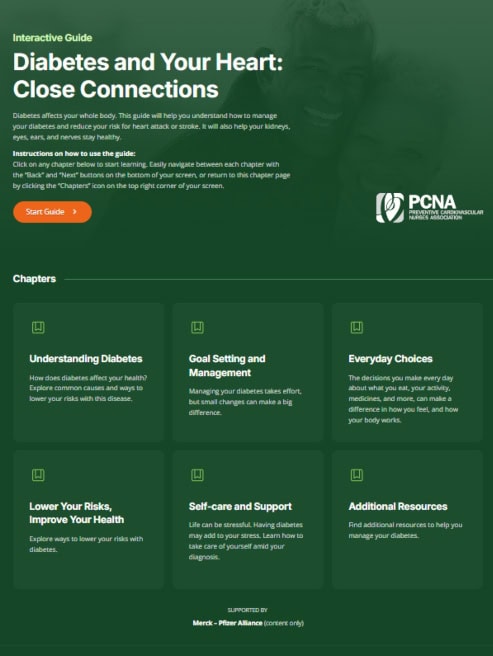
Diabetes and Your Heart: Close Connections Online Interactive Patient Tool
June 12, 2025

