






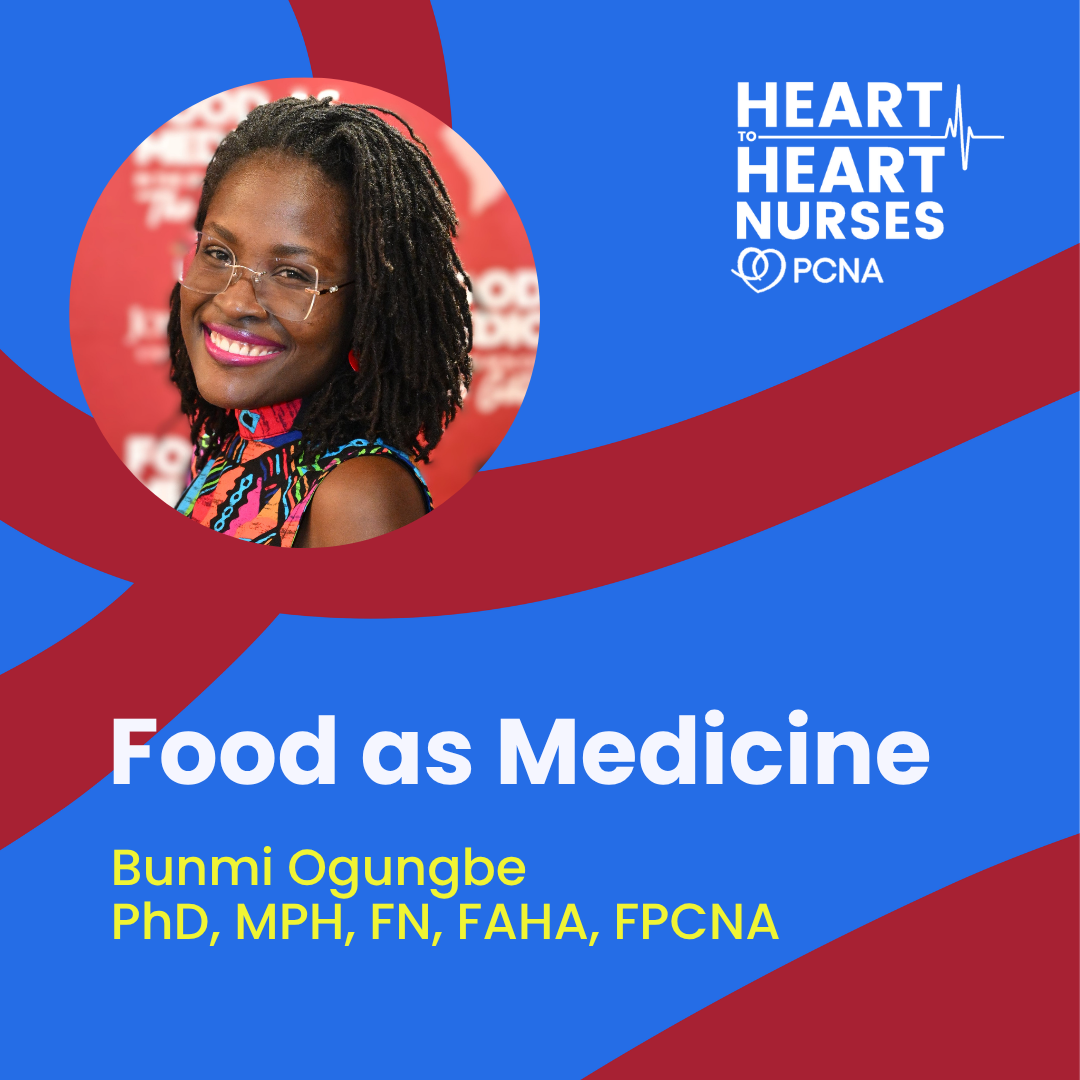
Learn how providing nutrition-based interventions can complement other treatments, address food insecurity, and help reduce patient risks for cardiovascular disease. Guest Bunmi Ogungbe, PhD, MPH, FN, FAHA, FPCNA. describes produce prescriptions, cultural tailoring, cooking skills, and the importance of policies that support access to healthy foods.
Episode Resources
I’m Erin Ferranti, board president for PCNA, and I’d like to welcome you to this episode of the Heart to Heart Nurses Podcast. PCNA is the proud home of cardiovascular nurses and one of the leading figures in the fight against cardiovascular disease. We have the resources you need for your day-to-day practice or to follow your passion to new areas of learning and growth.
Geralyn Warfield (host): (00:20)
I’d like to welcome the audience today for our discussion with Bunmi Ogunbe. And Bunmi, would you like to introduce yourself to our audience?
Bunmi Ogunbe (guest): (00:26)
Absolutely. I would love to. My name is Bunmi Ogunbe. I’m an Assistant Professor at Johns Hopkins University
Geralyn Warfield (host): (00:31)
Well, we are so grateful to you for spending time with us today. And you have a lot of expertise, but we’re going to start talking about a very near and dear topic to your heart, which is food as medicine. And I’m wondering if you could start us off giving just a general idea of what that really means.
Bunmi Ogunbe (guest): (00:45)
Right, absolutely. So, universally, we don’t quite have an agreed-upon definition just yet. But one thing I often like to say is that food as medicine has been around for centuries. And different cultures practice food as medicine in various ways.
What we are trying to do differently is the integration to the health system.
So, food as medicine, as we know it right now, are some of the interventions or programs or initiatives that allows us to implement nutrition-based interventions in a way that the health system can either cover some of it or at least support that effort.
And some examples are produce prescriptions which is what I do in my work. Medically-tailored groceries. Medically tailored meals. And, very fundamentally, the addition of medical nutrition therapy to be part of that process.
Geralyn Warfield (host): (01:35)
So how does a produce prescription or something like that work in the health system? Tell me from the perspective of I am a person in the health care system and I’m interested in getting these food sources to my patients. How does that exactly work?
Bunmi Ogunbe (guest): (01:48)
Now you’re asking the implementation science questions, which I love, because that’s what we want to do.
And I mentioned integration a while ago, that was very intentional. We do understand that the health system currently is overwhelmed. We don’t want to over-burden it some more. But we can integrate. We can implement things in a way that fits into the existing workflow.
So, if you’re a health care provider, you come across a patient who may have food access issues and sometimes may not even be experiencing extreme food access issues the way we know it.
You could screen them. It starts with screening. We have very short screeners for food insecurity, nutrition insecurity—not just food insecurity, but also nutrition insecurity.
We also have other screeners for social determinants of health which makes it a little
challenging for people to access healthy produce. And, as we know, a lot of social needs intersect. If a person is sort of low income, they’re more likely to probably be food insecure, and all these other things.
And so the process is screening them and identifying the need.
Once that is identified you may or may not be part of a health system that already has a food as medicine program going on. And what that means is, some health systems have programs, they have partners. So, there are sort of extend out of the health system, but they establish the relationship.
What they could do—or what you could do—is to refer that patient to them and then go, “This person seems to have some challenges going on, what can we do?”
The difference between just providing food to address food access, and food as medicine is, food as medicine is fundamentally—maybe not fundamentally, some people may not like my use of that word—but we are trying to do a little differently is using food to prevent or manage conditions.
So, this could be someone who has hypertension as an example, plus experiencing access needs.
So, you’re trying to manage from medication perspective, but we also know that diet definitely can help to improve their blood pressure, as an example. And so, you could refer them to that program and what they would do is have a dietitian actually prescribe, if it’s a food prescription program, prescribe the fruits and vegetables.
And in my study for instance, we can make akin to medication prescription. It’s so fun. The dietician goes, “Well, you need two bunches of broccoli. And it’s a shared process. It’s not just the dietitian prescribing. It has the word ‘prescription’ but we try not to be too prescriptive so someone hates broccoli, we wouldn’t put broccoli on their thing [prescription].
So, the dietitian sort of says, “This is what you would get this week, this is what you get this week.” And then that goes to whoever does the delivery, or like a food pharmacy that people can go to and pick it up.
Geralyn Warfield (host): (04:44)
So, does this often get partnered also with food preparation training? Because sometimes these fruits and vegetables might be not anything that they’d ever really dealt with before. So, they wouldn’t necessarily know how to adequately prepare the broccoli to keep it healthy.
I know that I’ve lived in different places where the go-to recipe is to always add meat, to add bacon to the broccoli or the beans or whatever it is, which totally, as you know, degrades the healthy perspectives of that particular produce item. So, sometimes there needs to be education that is shared with the patient and maybe their family and the community.
Bunmi Ogunbe (guest): (05:20)
Yeah, absolutely. Cooking skills. Ensuring that we’re not just giving people produce that they don’t even know what to do with in the first place.
Some of this starts from cultural tailoring. And I like to mention that a lot. In our work, people have told us, “Well, I do want to learn how to cook food from other cultures.” Or, “I do want to learn how to cook a vegetable that isn’t familiar to me.”
“But I also want to talk to someone, a dietician, someone, a nutritionist, who understands my cultural background. And when I’m trying to explain my flavor profile, they understand it, and they can tell me, ‘Well, this is where you can do it a little differently to make it both healthy, but also still very palatable and delicious and tasteful.’ “
So that’s, I think it’s such a critical component of it. Cooking skills—there are some programs that have cooking demonstrations. They have kitchens in the community. People come in and learn certain cooking skills.
There are things like recipe cards. So, for instance, in my study which is called Thrive—I realized, actually, I haven’t mentioned the name of the study—we give people recipe cards. So, every bag that they receive has a recipe card in it. These are just suggestions. Here’s a recipe. Oh, you’ve got radish and you’ve never really made radishes before? Well, here is how you can incorporate radish into your meal.
So, those are some ways. But I think we can probably do a lot more. I know some colleagues and I’m also beginning to do that in my work trying to build digital platforms and apps that convert a list of groceries into menu suggestions or meals, And then that converts into actual preparation tips. And some of that even could convert into a grocery list so that they can go get it.
So, trying to take the cognitive burden of, you know, I have this bunch of things that I don’t know what to cook, which I think happens to a lot of us.
Geralyn Warfield (host): (07:16)
Most every day, yes. You’re trying to come up with something palatable and something that, you know, your family will enjoy and eat and not have a ton of leftovers, you know, trying to be mindful of what the cost of these particular items are as well. So, I can see where that’s really, it’s a complex kind of web of information and education.
And as you said, being really respectful of what’s palatable, what’s culturally appropriate, and making sure that there’s a partnership between that healthcare professional, that healthcare system, and those patients.
Bunmi Ogunbe (guest): (07:52)
Absolutely. Very importantly, making sure it’s the kind of meal that would help manage or prevent whatever condition it may be that person has.
.
Geralyn Warfield (host): (08:03)
So how does this tie into medication adherence?
Bunmi Ogunbe (guest):
Aha! So here we go. I like to think of it as food is, as humans, most of us, maybe not every single one of us, we have this shared, something that we do share, oftentimes, something that collectively binds us is food. We are all are sustained on food. And that has become a part of the human experience from birth.
And that’s something where being used as medication is not so much. Medication for some people is a bit of an inconvenience. And so, we try to understand that. We tell people we know that you may not necessarily, especially people who have expressed to us—and I’ll come back to that point—but I also want to say that sometimes people get confused.
When we say food as medicine, they think we mean stop your medication and you’re only going to eat what we tell you to eat, which we’re flattered. But no, we don’t want people to stop their medications. We think it’s important to keep taking their medications.
So, we try to encourage people that this is supposed to be complementary. It is supposed to complement your medication. If you’re already on antihypertensives,as an example, we want you to continue taking it. We think it’s important to keep your blood pressure controlled.
At the same time, we can tell you what DASH diet means, know, Dietary Approaches to Stop Hypertension. We can tell you how to eat a low-sodium diet. We can teach you, and actually give you the produce that helps you get there a lot quicker.
And so, we think it’s more of a complementary relationship.
We stress medication. I think it’s great. I really hope that we start to do better as a population in terms of medication adherence, that more and more people adhere to their medication, but also to diet.
And the key thing here, you hear me saying, you’ve said it as well, is adherence. Both ways, not just medication, but also dietary practices, but also lifestyle, but also physical activity.
And human behavior is interesting. So anyway, we can talk a lot about that, about just what would it take to encourage people to keep to a specific lifestyle, their medication, food, physical activity, whatever it is, consistently.
Geralyn Warfield (host): (10:17)
That’s a very great point and behavior change is not a linear process as we all know. And I think having those check-ins with your Individual who’s given you this produce prescription, or is helping you with along this route, there are going to be slips. There’s going to be slides. It’s not going to be perfect all the time.
We need to make sure that as healthcare professionals, we’re understanding where our patients are coming from and being supportive of their journey. And checking in with them on a regular basis, I think, is something that is important for adherence for behavior as well as medications and all of those things. And sometimes that is really tough in a very busy clinical practice, but we really recognize the importance of that.
Bunmi Ogunbe (guest): (11:04)
Absolutely, absolutely and giving them the grace just as we hopefully give ourselves the grace.
Geralyn Warfield (host): (11:08)
I love that. We’re going to take a quick break and we will be right back.
Geralyn Warfield (host): (11:28)
We’re back with Bunmi, talking about food as medicine.
And there are some new therapies such as GLP-1s that have an impact on what you’re doing and I’m hoping you could discuss that for us a little bit.
Bunmi Ogunbe (guest): (11:38)
Yes, absolutely. So thrilled, as a lot of us are, that we have emerging therapies for many cardiometabolic conditions: GLP, SGLT2. Fantastic medications that are beginning to gain a lot of ground.
Before I get too deep into this, I should say that we know access is still sort of an issue. A lot of these medications are still expensive. People are having to get them through various means. And especially people who need them, in particular, people who have the highest burden of these conditions unfortunately still don’t have a lot of access to them.
So, I think it’s important to acknowledge that. I think it’s also important to tell patients how to get this. There are some medication assistance programs that people can get on and a lot of people don’t know about them.
But in terms of for this medicine and these medications, I think it’s a wonderful duo. We know that, I said it before, because food is such an integral part of the human experience that we can help people understand how to use that as their medicine. But at the same time, should people have the indications to get on GLPs and SGLT2s, we think it’s fantastic that they need to get on it.
And that combination, I said previously, can be complementary, can really help people have a sense that they’re in charge of health, that they are making wonderful changes and changes that they can see: A1C controlled, blood pressure controlled, and maybe weight as well, if that is a goal for them.
But fantastic meds. We’re glad that they are effective. We still have to wait to go because they’ve only been around for a few years. Some of the questions some of my colleagues have been thinking about is you know when do people stop? That has come up a lot as well. There are some unanswered questions that we continue to explore in research.
Geralyn Warfield (host): (13:32)
And could we talk a little bit about policy and how this affects what we’re talking about today?
Bunmi Ogunbe (guest): (13:38)
Yes, yes, absolutely. Actually, just yesterday I was on one of the Maryland Food System Resiliency Council, and some of the things that we were discussing were policy recommendations to make to the state.
And I’ve seen some of this as well as I talk to more and more colleagues. We’ve established that for this medication that’s been around for a while, actually has also been circularly for a while, just this momentum. This recent momentum kicked off around 2022, maybe a little before then, but there was a big White House food, hunger and nutrition conference.
And the wonderful thing about that conference was that a lot of the key partners were encouraged to make commitments. So, it wasn’t just, come listen to all of these things about for this medicine, and the about nutrition, and then go back to our respective places of business, and homes, but what are you actually going to do? What will be different?
A lot of large corporations made very big commitments. And for our study, for instance, got funded through the American Heart Association which has a food as medicine, they call it Health Care by Food, initiative. But anyway, this momentum started around that time and now we have a lot of policy, Black health as well.
Through Congress, too, there have been some big investment for these food as medicine initiatives. One of the good things that has come through CMS, Center for Medicaid and Medicare Services, is the waiver, 1115 Demonstration Waiver. And that is how a lot of states are trying to implement initiatives like social needs, meeting social needs, but also food as medicine as well.
So, some of the policy recommendations that we’ve been trying to make to states, for instance, the one I was on yesterday to the state of Maryland, is perhaps consider for this medicine as one of the demonstration projects under this waiver, since it does exist.
I’ve had conversations with medical officers of CMS, and some of the things that we’ve heard is that they would encourage us to get more of the effectiveness data. Cost effectiveness, clinical effectiveness. Some of these exist, but some are little mixed. And the more data that researchers like me, and my colleagues, can put out, the better we can support and inform that policy.
They want to know what are the implementations factors? What do they need to consider? What are the barriers, right, when they are recommending this to health systems? What are some of the facilitators? What should they have in place? What should health system have in place to be able to implement for this medicine programs?
So anyway, I think the key point is we do have an opportunity here to inform policy in various ways, state and federal efforts, to encourage investment in for this medicine initiatives, investment in for this medicine programs.
I sometimes say that we have a reactive health system. We wait until people get through the conditions and then we throw everything at it. And it’s wonderful that we’ve made really wonderful medical advances but we know that prevention is so much more cost-effective. And people actually feel better when they are able to prevent a condition if it’s preventable.
And you know most cardiovascular conditions are preventable. So, I think there’s a unique opportunity to influence policy to the extent that we can in the food as medicine space.
Geralyn Warfield (host): (17:29)
Bunmi, my final question for you is what one key takeaway would you like to leave with our audience?
Bunmi Ogunbe (guest): (17:36)
Well, that there is huge promise in the food as medicine space. That there are several skills that comes along with being part of a food as medicine initiative or program that people can actually implement. It’s all within our reach, that we can implement. And that more than ever, we know that a lot of nutrition-based interventions can help, can actually help manage conditions and not just prevent it. And I think that’s a fantastic promise.
Geralyn Warfield (host): (18:04)
Thank you so very much for being here and sharing your expertise with us. We really appreciate you.
Bunmi Ogunbe (guest): (18:07)
Sure, absolutely.
Geralyn Warfield (host): (18:09)
This is Geralyn Warfield, your host, and we will see you next time.
Thank you for listening to Heart to Heart Nurses. encourage you to visit PCNA.net for clinical resources, continuing education, and much more.
Topics
- Lifestyle and Behavior Change
Published on
April 7, 2026
Listen on:
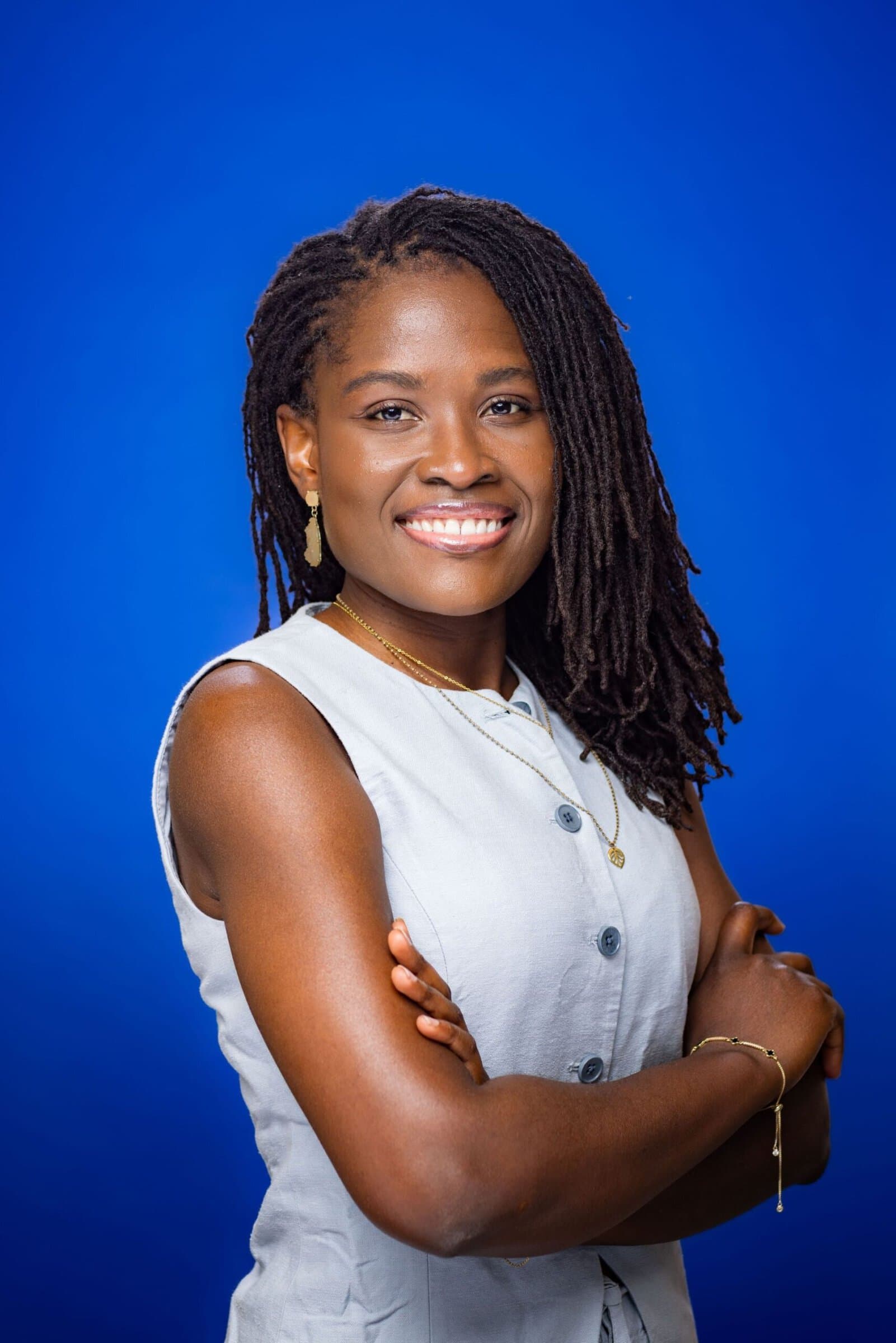
PhD, MPH, RN
Related Resources