





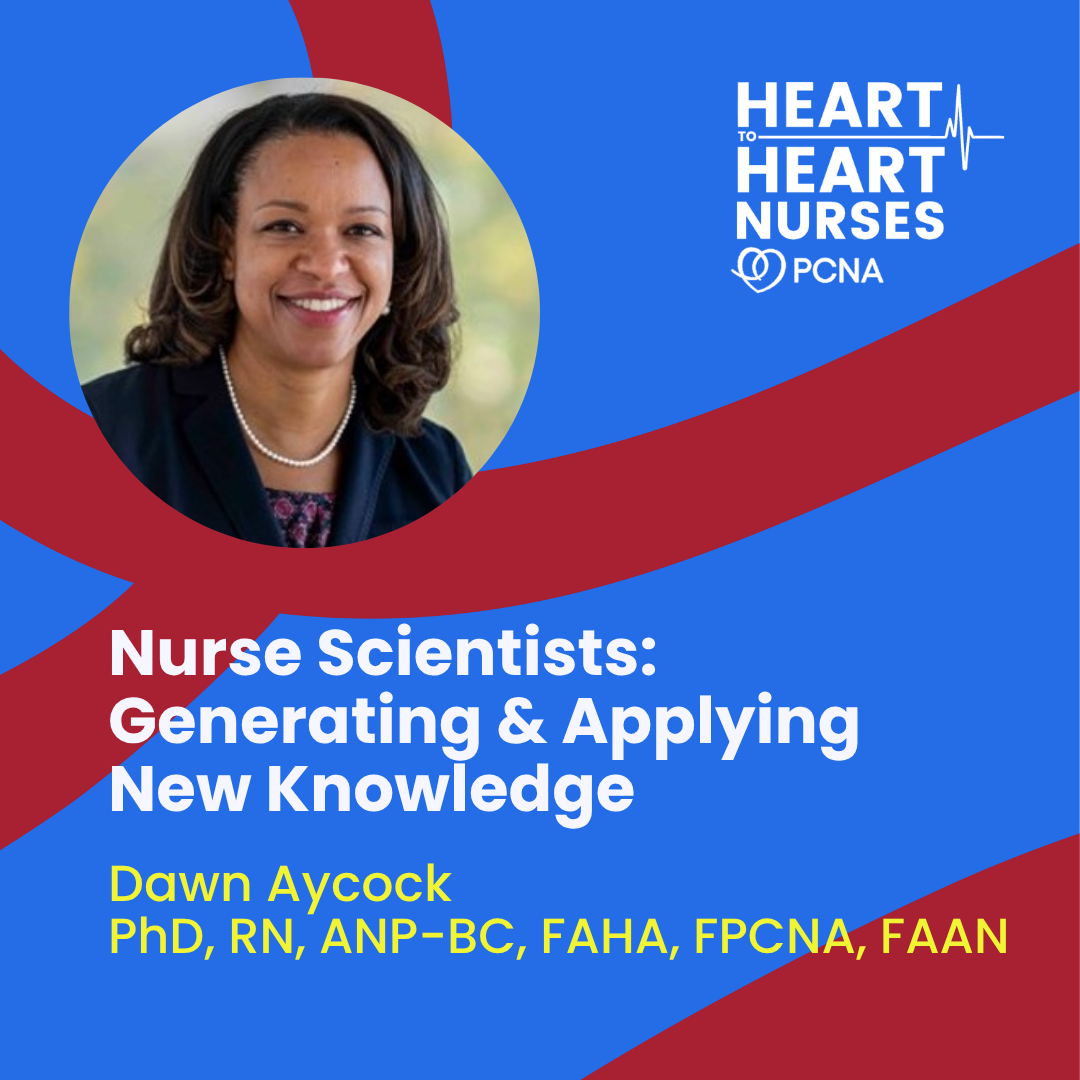
What is a nurse scientist, and what is the difference between one who is PhD-prepared versus DNP-prepared? Guest Dawn Aycock, PhD, RN, ANP-BC, FAHA, FPCNA, FAAN, shares the importance of nurse engagement in research and how to get involved, no matter your role or location.
Episode Resources
I’m Yvonne Commodore-Mensah, Board President for PCNA. I’d like to welcome you to Heart to Heart Nurses. PCNA supports your professional journey with accessible continuing education, practical patient resources and a vibrant community that understands the unique challenges and rewards of cardiovascular nursing. Together, we’re advancing the knowledge that defines excellence in cardiac care while celebrating the difference you make every day.
Geralyn Warfield (host): (00:20)
I’d like to welcome our audience today to a conversation with Dawn Aycock. Dawn, could you introduce yourself?
Dawn Aycock (guest): (00:26)
Hello everyone, I’m Dawn Aycock. I am a nurse scientist in cardiovascular disease. I’m also a professor in the School of Nursing at Georgia State University and the PhD program director.
Geralyn Warfield (host): (00:37)
Well, Dawn, one of the reasons that I am so excited to have you in our discussion today is to talk a little bit about nurse scholars and what it really takes to be a leader in scholarship and in research. So, I’m hoping you could talk to us a little bit about what a nurse scholar is, what they might do, because many of us may not be very familiar with that.
Dawn Aycock (guest): (00:56)
So, a nurse scholar, of course, is a registered nurse, or it could be a nurse practitioner, but someone that really focuses on research and scholarship as well. And generating new knowledge, sharing that knowledge, also applying that knowledge to practice. So, it could be a nurse scientist, or it could be a nurse researcher.
Geralyn Warfield (host): (01:19)
So why do you think most of us are very unfamiliar with this role?
Dawn Aycock (guest): (01:23)
So, when we think about registered nurses, we typically think about nurses at the bedside and can’t think beyond the bedside. And so, people may lack awareness about the role. Also, less than 1% of nurses are nurse scientists. That’s PhD-prepared nurse scientists. We have more that are DNP-prepared nurses.
And the difference between the two: PhD-prepared nurses generate new knowledge. So, they’re doing, conducting their own research and generating that new knowledge. DNP-prepared nurses are taking that knowledge and applying it to practice.
Geralyn Warfield (host): (02:02)
And so where does your role fit into that continuum of education and research and action?
Dawn Aycock (guest): (02:09)
So, I am a nurse scientist, PhD-prepared nurse scientist. I have a program of research in primary stroke prevention in young adult African Americans. In the past decade, we’ve seen an increase of stroke among young adults. And it’s traditional cardiovascular risk factors that are contributing to that increase. So, we’re seeing higher rates of hypertension, diabetes, and obesity.
And I’ve developed a stroke counseling for risk reduction program called SCORE to increase overall awareness of stroke, to improve accuracy of perceived stroke risk, because many young adults don’t think that they’re at risk of stroke, and also to promote healthy lifestyle behaviors to reduce stroke risk.
And so again, I’m a nurse scientist, and also I am, as I mentioned earlier, director of the PhD program at Georgia State University, where I’m educating the future nurse scientists.
Geralyn Warfield (host): (03:03)
So, what are some tips, what are some of your suggestions that you might have for nurses who are studying to be nurses or individuals who are early in their career? If they have some interest in this, where can they go for more information? How would they go about that?
Dawn Aycock (guest): (03:19)
That’s a good question. If you were to probably put nurse scientists, do a search on the internet, there’s not a lot of information. And so that’s one thing that we need to do. We need to do a better job of increasing awareness about the role of nurse scientists and nurse researchers and how individuals can become a nurse scientist.
In talking with students and individuals that are not nurses, I often hear, “Well, I didn’t know nurses could do that.” You know, I’ll talk about my SCORE program and people will say, “Well, I didn’t know that nurses could, you know, could actually do that.”
And so, for individuals that may be interested, they may, I would say, identify a mentor, someone that is in that role like myself, meet with them, talk with them, see what they do, and also see how they got to where they are.
So, for example, myself, I got interested in nursing research when I was in undergraduate nursing program. I heard about nurses that were doing research just across the street from where I was in nursing program. It was at Baylor University where I heard that these nurses were doing research. And I thought to myself, “That’s interesting.” I didn’t know that nurses could do that.
And I was able to get involved in research a couple of years after I graduated with my undergraduate degree and fell in love with research.
So, there are opportunities out there for individuals that may be interested in research. There’s job opportunities, but there’s also education as well. Continuing education, going on to get your Doctor of Nursing Practice degree or your PhD, depending on what your career goals are.
Geralyn Warfield (host): (05:08)
Is this also something that an individual could come to later in their career?
Dawn Aycock (guest): (05:12)
Absolutely, yes. I would say on average for PhD programs we do see some individuals that are later in their careers that come into a PhD program. Although we really want individuals earlier in their careers so they can have longer careers as nurse scientists, but it’s definitely something that individuals that are later in their career can do.
And we really encourage those individuals to think about it because they have a lot of experience. Wherever they are, whether they’re in the hospital or in community setting, they have seen what may work and what doesn’t work when it comes to nursing, and they have questions that can be answered through research.
Geralyn Warfield (host): (05:57)
We are going to take a quick break, and we will be right back.
Geralyn Warfield (host):
Welcome back to our audience and to our guest, Dawn Aycock, who’s here discussing nurse scholars with us. And right before the break, we were talking about how you can come to this at any point in your career, although we’d love to get individuals involved earlier in their career so that you can contribute to research and be involved in that for longer.
But I’m wondering what it takes to really be a great nurse scholar.I suspect that most of us might lack some skills and maybe even some confidence. Is that accurate?
Dawn Aycock (guest): (06:29)
Absolutely. I’d like to share, just last week I was talking with one of our PhD students and she told me, she said, “You know, you told us in one of our classes that we needed to network. We needed to get to know people so that we could build up our network of individuals that could contribute to us and help us learn, definitely when it comes to our research areas of interest.” And she said, “I thought to myself, I don’t know how to network.”
And so, when I heard that, I was a little taken back. I was surprised. I was like, “Hmm, you don’t know how to network? Everyone should know how to network.” But I think a lot of times as experienced nurses, we may sometimes forget those soft skills, that people don’t have those soft skills. And so that is something, that’s an area where we can come in and we can assist these individuals how to network.
I’ve also had students that will say, “You know, I didn’t know that I could do such and such. I didn’t know that I could analyze data, that I could publish a manuscript, or that I could earn my dissertation.” And this was after it had been done.
So, before that, they were probably like, “I don’t think I can.” So that is an area where, as experienced nurses, we need to build their confidence and give them opportunities so that they can develop those skill sets. Give them opportunities to write manuscripts, whether they are co-authors on a manuscript that you are on, that you’re writing. Coming to professional organizations like PCNA to present findings is a great skill set to have, as well.
Geralyn Warfield (host): (08:11)
One of the other things that I think is a struggle for many individuals who are looking for ways to improve themselves in their career is finding somebody to mentor them. You talked about that, but also for those that are possibly doing the mentoring or doing that support. Could you give us some pointers as to how we might make that process a little less clunky?
Dawn Aycock (guest): (08:30)
Yeah, I think one of the things is that we have to make time to be mentors and we have to take on that role. My mentor, who was a wonderful mentor, I wouldn’t be here without my accomplishments if it wasn’t for her, but she told me that the reason why she mentored was to pay it forward. And as nurses, we have to remember that. We need to pay it forward.
And so we have to make, like I said earlier, we have to carve out time in our busy jobs in order to do that. And to really give back. Because we know that nursing is a science, and that we need to continuously evaluate what we do, update what we do because we know that healthcare is always changing, but we also know that there are ongoing inequities and disparities when it comes to healthcare.
And so, as nurses, because we see so much and do so much, we are the individuals that are needed in order to identify the problems that we see in healthcare and address those problems. And that could be done through research, or in being a nurse scholar that can be done.
Geralyn Warfield (host): (09:47)
If you had one takeaway from our conversation today that you would like to leave with our audience, what would that be?
Dawn Aycock (guest): (09:53)
I would say just do it. And I have a talk that I typically give to nursing students, and that’s the title of it, just do it. Because you really don’t know what can happen as a result, and who you can influence, or the impact that you can have.
And so, in just doing it, that means going ahead and writing up a manuscript and trying to get it published. Or presenting at a conference because again, you don’t know who you might inspire on their job or in their education or what impact you may have.
Geralyn Warfield (host): (10:32)
It has been a delight spending time with you today, Dawn.
Dawn Aycock (guest): (10:34)
Thanks for having me here today.
Geralyn Warfield (host):
Well, thanks for joining us. This is Geralyn Warfield, your host, and we will see you next time.
Thank you for joining us for this episode of Heart to Heart Nurses. We invite you to visit pcna.net for education and resources that will empower you to provide preventive cardiovascular care with confidence and expertise.
Topics
- Professional Development
- Research and Evidence-Based Practice
Published on
August 18, 2026
Listen on:
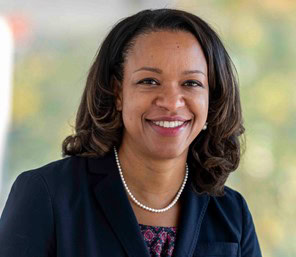
PhD, RN, ANP-BC, FAHA, FPCNA, FAAN
Related Resources