







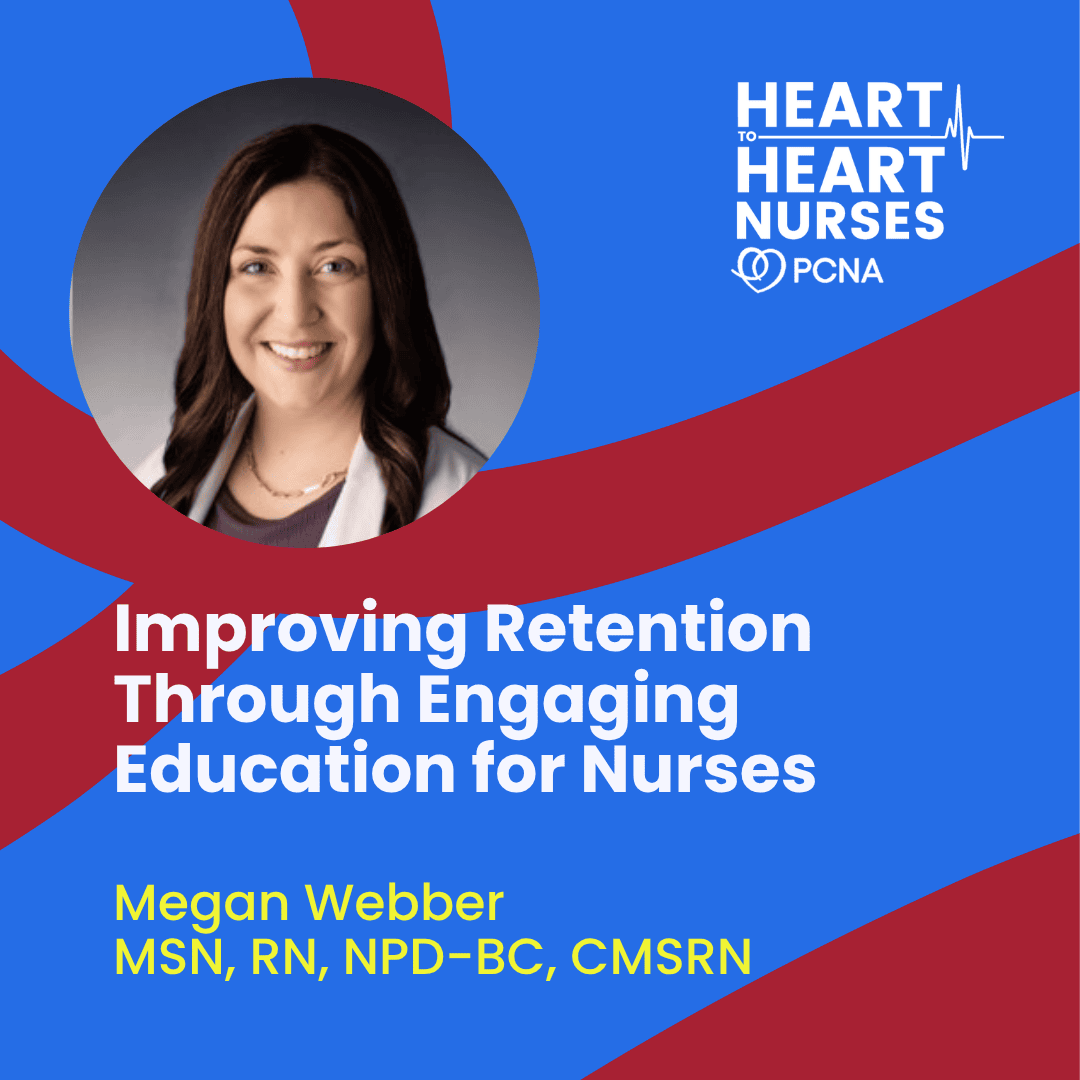
Engaging education helps to improve knowledge and skills retention by nurses at every stage of their career. Learn how to gamify information in clinical settings as well as classrooms–and how the same techniques can also assist patient learning.
Episode Resources
[00:00:00] I’m Erin Ferranti, board president for PCNA, and I’d like to welcome you to this episode of the Heart to Heart Nurses Podcast. PCNA is the proud home of cardiovascular nurses and one of the leading figures in the fight against cardiovascular disease. We have the resources you need for your day-to-day practice or to follow your passion to new areas of learning and growth.
Geralyn Warfield (host): (00:20)
I’d like to welcome our audience today to our discussion with Megan Weber. And Megan, could you introduce yourself to us, please?
Megan Webber (guest): (00:26)
Sure. I’m Megan Weber. the Manager of Clinical and Professional Development at Mercy One in Dubuque, Iowa. I’ve been in this role for about six months, so I am learning nursing leadership currently. But prior to that, I had about 10 years of experience as a nursing professional development specialist. And my background clinically is surgical and trauma. So, I am not a cardiac whiz. I’m not a cardiac nurse, but I have some other specialties that I’m hoping to talk to you about today.
Geralyn Warfield (host): (00:56)
Well, we are so grateful to you for spending time with us today. And this particular topic is slightly different than some of our subject matter that we have covered in the past, but it’s super important as we’re talking about improving our workforce overall.
And it’s really about how to help nurses learn the information that they need, how to feel empowered, how to feel engaged, how to feel confident. And so, in order to do that, we have to provide them with information in training. So could you talk to us about what kinds of engaging strategies we can use in nurse education?
Megan Webber (guest): (01:28)
Right, yes.
You know, I think definitely the days of the lecture are going by the wayside. I struggle myself to sit in a room for hours, hours on end, and listen to someone talk. I am not an auditory learner. I know that I’m a more visual learner, so, good visuals on the slide can be very helpful. But having the sessions broken up into smaller chunks, and also bringing in engaging strategies can help with retention.
If we’re thinking of nurses coming through orientation, for example, we are always making sure that we want to incorporate interactive activities, whether it’s even they’re standing up and they’re doing a scavenger hunt around the hospital to find the different departments they’re looking for, or maybe it’s time that we set up a skill, maybe the IV arm so that they can practice their skill instead of just learning about how to put in that IV.
I also help coordinate our nurse residency program for our new grads. And again, they’re coming for a couple hours, once a month. And for them, as younger learners, typically, coming out of school, they, again, don’t want to come in and sit and listen to somebody talk to them for three hours. So, through that, it’s really important that we incorporate some other strategies.
So, some of the things we’ve done are bringing in games. We bring in things like case studies. We do escape rooms. Even simple things, like quizzing, small group activities, are all different ways that I’ve used to get engagement and just prevent people from falling asleep, honestly.
Again, like I said, it’s hard for me to sit in a lecture hall and listen to somebody talk for an hour on end without something to break it up. So, when you’re getting beyond that, I think it’s really important that we’re bringing in something engaging for them.
Geralyn Warfield (host): (03:24)
I think that education overall has shifted dramatically in the last few years for all ages, and particularly for busy adults. Adult learning is this whole own scope and sequence of activities that really work for adult learners, and you’re right that that engagement’s important.
It’s also really important to see that direct applicability to what they do. Yes, it’s great to have the statistics, it’s great to have some of that information. But what does that mean for me in practice?
So, for those that are in direct patient care, how do you modify, or what are some great things that you’ve been able to see and do in your facility that really seem to work?
Megan Webber (guest): (04:01)
I think to speak specifically to what you said about ‘applicability to me,’ no matter what method I’m using for education, that is really key, like you said, in our adult learners, no matter what generation it is. They want to know the why behind…we’re doing this for what reason?
Usually, it’s a big change that they have to go through. They might have to completely change their workflow. And to help them understand why are we doing this, just stop for a minute and understand here’s the background and what’s in it for me kind of thing. How is this going to benefit me? So, thanks for bringing that up.
Thinking of nurses that are in direct patient care, they typically can’t come and sit for an hour-long education session. That would be great if we could do that all the time and make it interactive. But we really have to be able to bring it to them in their clinical practice.
So, ways that I’ve done that have been, we do a lot of ‘rounding road shows,’ we call them. So, we pack up our cart, and we have a few different topics at a time. We’re not going to cover everything, but we have a few things on our cart that we want to talk to them about.
And it’s really that micro learning that we’re doing, right? Like it’s short, five-minute snippets for each topic, probably maximum, to help them really understand what the key points of those are.
So, one of the activities we did was related to proper disposal of medication waste. We were really struggling with people putting things in the wrong bins. So, what we did was we came up with an activity, and I’ll give a shout out to my colleagues at Mercy One Clinton in Dubuque, Iowa, because they really helped put this together.
But we had little paper cups, or Styrofoam cups, and they were the different waste receptacles. And then we just had little strips of paper with different types of medication. So maybe it was Coumadin, maybe it was IV morphine—different things that we have to kind of think about, where are we going to put those when we waste them?
So, by making it interactive and making it hands-on, they were able to not just read a piece of paper and try to learn it that way, but by doing it with a tactile mechanism included, it could help them be able to apply that more readily.
Geralyn Warfield (host): (06:14)
So, in that case, they’re putting the name of the medication in the proper receptacle. Now here’s my question: Did you time them? Did you have a contest?.
Megan Webber (guest): (06:21)
We did not have a contest for that one. But can I speak to contests?
So, one of the things I was hoping to talk with you about is gamification. So, actually my presentation here at the PCNA convention [in April 2025] is really bringing in gamification. So, you’ve maybe heard of that topic. But if not, it’s the use of game design elements in a context that is not necessarily a game.
It’s to help make learning engaging, interactive, and enjoyable so that our learners are not just passive learners, right? They’re involved, they’re engaged.
There have been some studies done on this. I had to look that up to see before I came to talk with you today, but it definitely needs more research.
They have found that there’s been improved cognitive learning outcomes when gamification is incorporated, and also that learners are more likely to remember when we tie learning to something that’s a more meaningful or emotional experience.
Different ways we can use gamification would be any activities that include points, like you said, timer, leaderboards, challenges. And there’s lots of programs out there. Most of them do involve technology, but you can potentially make your own game using something that’s not necessarily web-based or on the computer. But you need a few supplies for that, most likely.
Geralyn Warfield (host): (07:42)
So, can you give us another example of how you’ve used some of these amazingly wonderful, engaging strategies in practice?
Megan Webber (guest): (07:49)
I’ll just share a little bit about what I’m going to be doing today, if that’s okay. So today for my presentation, I’m going to be using Kahoot, which is an online quizzing platform for some engagement. And for this, it is going to be a competition today.
So, I have everyone in the room broken up into teams. So, they’ll be sitting at their tables. They’ll have their own phones to do the answers, but everyone sitting at that table is able to participate to their team score. And then at the end, I’ll be able to give them out a nice little prize. So, we’re using that today. We’re going to do just a really quick, refresh presentation, five minutes on the topics. And then we’re to go right into the quizzing.
Some others that I’ve used have been using a scavenger hunt application. So, you can either use an online, actual, formal scavenger hunt platform, or you can actually do it yourself. I’ve done it using Microsoft Teams before when I didn’t want to pay for the subscription. But you can use several different types of scavenger hunt activities.
We have used it for more like an icebreaker type activity, but also to learn. So most recently I used it for our nursing shared governance meeting. We’ve recently revamped our structure for shared governance. And so, during our first meeting where we were bringing all these new members together, we set up a scavenger hunt that they were going around the hospital with each other, small groups, and they had to post pictures of things that we wanted them to find.
So, for example, “find a certified nurse,” or “you need to go find the CNO” because he has an impact in shared governance. So, I’ve used it for that and other things like orientation.
Also, of course, there’s escape rooms. So, escape rooms, that’s going to take a little more dedicated time that people would have to leave their work department and to be able to come to do it. But it’s another way to apply their learning into actual practice.
So, we’ve created escape rooms for things like a stroke situation. So, a patient coming in through the ED and the nurses have to go through different steps and solve different puzzles to be able then to kind of ‘solve’ the escape room as they ultimately also take care of their patient and learn about stroke.
Geralyn Warfield (host): (10:04)
Those sound really engaging and exciting, and I wish I could follow you around all day, because it sounds like you’ve got a great job.
Megan Webber (guest):
Yes, it is. It’s really fun.
Geralyn Warfield (host):
That’s awesome. We are going to take a quick break, and we will be right back.
Geralyn Warfield (host):
Welcome back. We’re excited to be here with Megan, who’s speaking to us about learning, as a nurse, and with nursing staff. And she has a few more thoughts about gamification she’d like to share with us.
Megan Webber (guest): (10:09)
Yes. So, just want to give another plug to why you should consider gamification if you are having to build education for your nurses.
So, have you ever kept playing an app because you didn’t want to break your streak? Right now, I’m pretty proud of myself. I am on streak day 70 for Duolingo for Spanish. So, pretty proud of myself and I don’t want to break that anytime soon.
So, if you think of a game that has a challenge, or points, or you have to meet these milestones, it really does drive your motivation.
People want to win. They want to reach a certain status. There can be quests or challenges that you want to complete. And all of that is gamification. We use it in our daily lives, maybe if it’s not even for learning.
So really, the moment you turn learning into a game, maybe it’s a simple quiz or it becomes more engaging potentially, it really does help to drive that motivation, like I said.
I also just want to mention too, this really does cross generations. So, it’s not just the Gen Zers that are interested in playing games. It really…maybe have different motivations amongst the generations for why they want to participate in games.
So, for Gen Z, they do tend to enjoy the fun, the creativity of the games. For Millennials, they really are driven by being able to show progress and to get recognition and feedback from those games. And then for the Gen Xers and Boomers, it’s when there’s able to be some clarity, structure, and incentives from playing those games.
Geralyn Warfield (host): (12:02)
I won’t tell you what day I’m on with Duolingo, but you’ve got a little ways to go until you get here.
Megan Webber (guest):
I bet. I bet I do.
Geralyn Warfield (host):
Likewise, I am also motivated to not miss my streak. I think about it, it might be very late at night, almost midnight, and I’m like, oh my gosh, my streak. That is an incentive for us.
So, in addition to helping onboard new nurses and new grads, what other applications do you see for this?
Megan Webber (guest): (12:27)
Yeah, sure. So, there are potentials for utilizing this with our patients. So, there are some apps out there already that incorporate maybe even just a small amount of gamification. And I’m actually really interested in looking into this more myself to see if there’s something at my organization we could implement and study to see the efficacy of it.
But there are some apps that I was looking around at. And one of them is maybe not necessarily for patients, but there’s one called Zombies Run. Have you heard of that?
Geralyn Warfield (host):
I have tried it.
Megan Webber (guest):
There we go. Was it to try to run a 5k?
Geralyn Warfield (host): (13:05)
Yep. It basically, they provide you with incentives to go a little bit faster. So, there’s a story line that’s happening in the back. So, as you’re running, all of a sudden, there might be zombies chasing you. So, that encourages you to pick up your pace, and then, you know, you might outrun the zombies, and then you can go back to the regular pace. So, it definitely is a health incentive to try and improve your pace, at least temporarily. So, doing some sprints in the middle.
Megan Webber (guest): (13:28)
Well, and as I’ve seen some of the presentations today and the poster presentations about cardiac rehab, I think that somebody, maybe they’re already doing it, but somebody should look at, you know, gamification for those cardiac rehab patients. Maybe it’s not Zombies Run, but maybe it’s something similar that’s driving those patients to be motivated to continue with that.
There are programs out there for diabetes. There’s one called My Sugar that has quests and challenges, if you’re staying on top of checking your blood sugars and track those. And then, actually, speaking of cardiac rehab, I did find that there are some sites that are out there that are using more gamified modules for their education that they’re providing.
And they’re also using virtual reality.
And this morning at one of our presentations, there was someone that stood up and made a comment about how we can’t just educate and just think that the patients are going to be good from there. We need to be able to get them to actually do the activities we’re telling them to do, right? So, I could see games really turning those passive patients into more active participants.
And that can really help shift things from just, you know, receiving this information and not really knowing how I’m going to do, it to potentially moving it into something more motivating that could be in maybe smaller chunks, or we’re going to meet this challenge just today and we’ll see what’s going to happen next. That could really help motivate those patients.
Geralyn Warfield (host): (14:54)
I can definitely see this being used in behavior change modification. And just like Zombies Run, sometimes you’re going to outrun them, sometimes you’re not. Sometimes you’re going to be on point with your blood sugar, sometimes you’re not.
I think being positive and encouraging really goes a long way no matter what the standard is that you’re using to try and educate these individuals.
I have one more question for you, and that is if you had one takeaway for our audience today, what would that be?
Megan Webber (guest): (15:22)
My takeaway would be to just keep an open mind about learning and how it can be done. A lot of us are used to more traditional methods, but there’s a lot of opportunities out there to incorporate more interactive ideas.
And it does not have to be an elaborate game with all sorts of rules and game pieces and things like that. It could be as simple as adding in a few quiz questions if you’re doing a presentation, or bringing something to those nurses in clinical practice that instead of just giving them a handout to read or to talk at them, to incorporate something small where they can get their hands in it.
Or maybe it’s on some questions instead of telling them the information. Maybe you put it in just a question format.
So, I would say just, yeah, keep your mind open and maybe look for ideas that might be out there already to help you bring some interactivity to your education.
Geralyn Warfield (host): (16:17)
Well, Megan, thank you so very much for being here today, for sharing your enthusiasm for education and different ways of helping nurses get information and knowledge and skills that they need to do their jobs even better.
This is your host, Geralyn Warfield, and we will see you next time.
Thank you for listening to Heart to Heart Nurses. Visit PCNA.net for clinical resources, continuing education, and much more.
Topics
- Professional Development
Published on
March 31, 2026
Listen on:

MSN, RN, NPD-BC, CMSRN
Related Resources
Sorry, we couldn't find any resources.
