






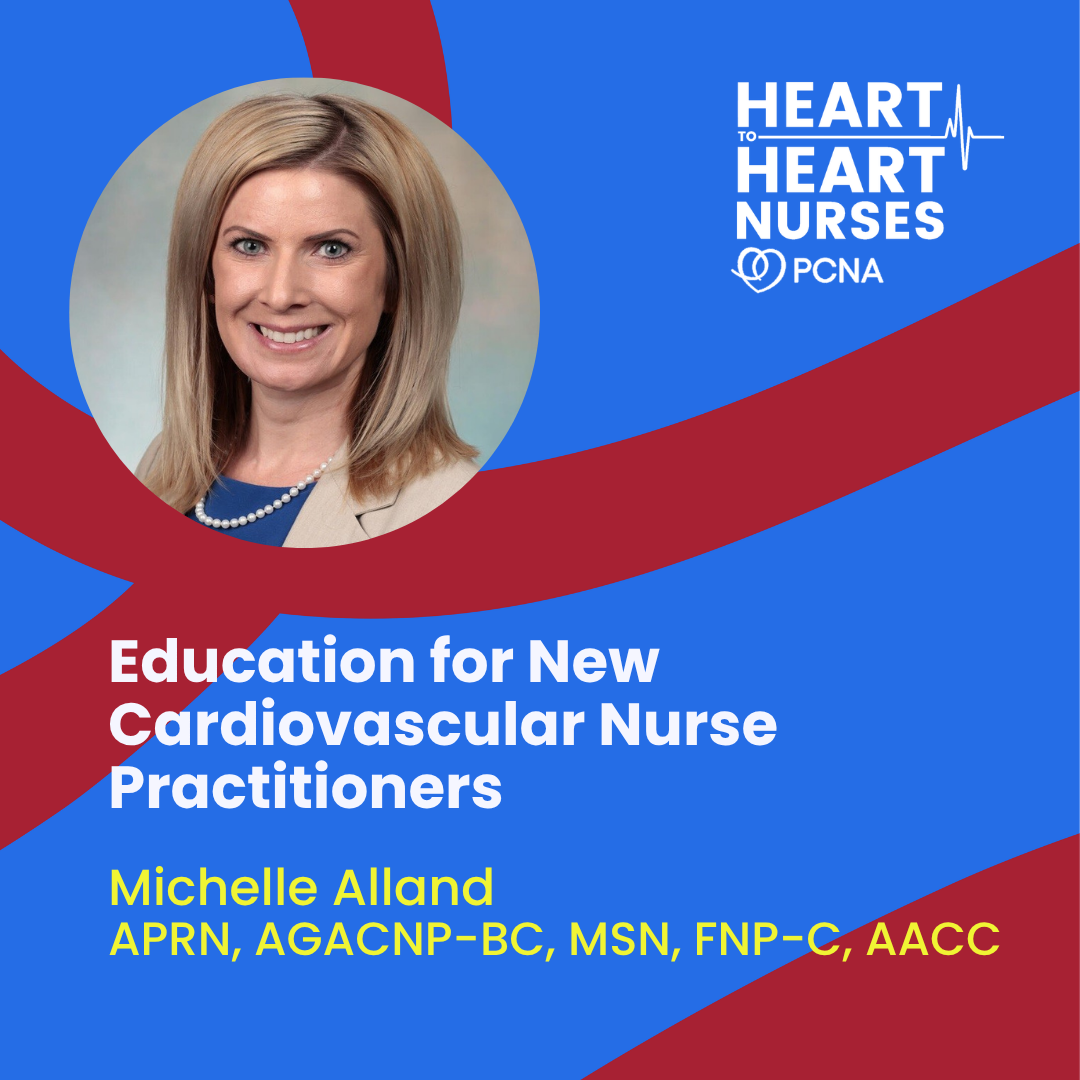
“For new graduates of nurse practitioner programs, cardiovascular-focused knowledge and skills can be improved with additional professional development opportunities. Guest Michelle Alland, APRN, AGACNP-BC, MSN, FNP-C, AACC, describes postgraduate fellowships, local and national training options, onboarding, and the importance of mentorship from more tenured NPs.
Episode Resources

I’m Yvonne Commodore-Mensah, Board President for PCNA. I’d like to welcome you to Heart to Heart Nurses. PCNA supports your professional journey with accessible continuing education, practical patient resources and a vibrant community that understands the unique challenges and rewards of cardiovascular nursing. Together, we’re advancing the knowledge that defines excellence in cardiac care while celebrating the difference you make every day.
Geralyn Warfield (host): (00:31)
Welcome to today’s episode and I’m so excited to have the opportunity to talk to Michelle Alland about nurse education and what that’s been like in her life. But before we get there, let’s have her introduce herself to you.
Michelle Alland (guest): (00:43)
Hi, I’m Michelle Alland and I’m currently a Nurse Practitioner on an inpatient cardiology service. I’ve been in this role for about 13 years already. It’s crazy how quickly the time goes by, but it’s the one and only job I’ve had since graduating nurse practitioner school and I’ve stuck around because I really enjoy being in a role that has a lot of flexibility and see a big variety of patients.
Geralyn Warfield (host): (01:06)
So, when you leave nursing school, no matter what that level is, your education, of course, never really stops. So, I’m hoping you can talk a little bit about your trajectory of education since you left nursing school in terms of keeping your skills and your knowledge always up-to-date.
Michelle Alland (guest): (01:21)
You know, nurse practitioner school is a lot of information over a very short period of time, but I always knew going into being a nurse practitioner that I wanted to work in cardiology. It’s always an area that I gravitated towards, but I felt like even though I wanted to seek out a job in cardiology, I wasn’t quite ready, right?
Making that transition from graduating school to starting in your first job is kind of a daunting feeling. So, when I was searching for positions in cardiology, I actually came across a position in a postgraduate training program. And I thought, well, that seems interesting to me. Maybe I’ll apply for that and give that a shot and see if that works out.
And it did. And so, I actually moved to Arizona to pursue this fellowship position, which was for a year, and just got to live and breathe cardiology for an entire year, which was fantastic.
And it really helped ease that transition between graduating nurse practitioner school and building more confidence to kind of start my own career. So, it was like a great bridge in between the two. And I feel like it really helped ease that transition.
Geralyn Warfield (host): (02:31)
So where did you find out about this fellowship, or where would people look for those kinds of opportunities?
Michelle Alland (guest): (02:36)
So, they’re still not very common; they’re becoming a little bit more common. I happened to just find it in a random Google search.
But one could simply look online. There’s, I would say, maybe around 12 of these different fellowships for nurse practitioners now across the country. Various different states. So, if it’s something that piques someone’s interest, I would definitely encourage them to seek that out.
And my hope is that with time, there may be more of these programs that start to come out because I saw the value that it gave me in furthering my career and really preparing me to be successful in cardiology, which can be a very challenging specialty area to be in. So, it’s something I’d hope to see more as time goes on.
Geralyn Warfield (host): (03:19)
So, outside of fellowships, what other opportunities have you seen, or your colleagues, or maybe you’ve seen advertised? What’s available out there when we’re talking about trying to improve our skills?
Michelle Alland (guest): (03:28)
Obviously, conferences like PCNA are a great opportunity, but there’s a lot of national and even local organizations that might host educational events. It can range from things locally, maybe even within your own institution, to seeking out things on a more national level like PCNA.
But there’s definitely a lot of educational opportunities.
I’m lucky that I work at an institution that’s a teaching hospital. So, I get a lot of education just within my own hospital, which is great. It’s easily accessible. And I’m also fortunate that I get some support from my institution to attend these types of conferences as well.
The interesting thing is that when I started off my journey as a nurse practitioner, I felt very much like I needed all the education I could get. Now I’ve been in my position long enough, I feel like I’ve gained enough experience and confidence to kind of flip the script and be able to start teaching others.
And that’s a really interesting transition that I hope others can seek out as well, as you gain more knowledge and experience in your field to seek out the opportunity to be able to teach others as well.
Geralyn Warfield (host): (04:43)
We’re going to take a quick break, and we will be right back.
Geralyn Warfield (host):
We’re back with our discussion with Michelle talking a little bit about what professional development can look like in clinical practice and as you are going through your career. And I’m wondering if you could please talk a little bit about the importance of onboarding.
Michelle Alland (guest): (04:58)
So, I was very fortunate that I had the benefit of a prolonged fellowship, which really helped ease the transition because I ended up working where I had my fellowship. But of course, that’s not available to everybody.
And so definitely, if you’re seeking out a new position, one thing I would encourage people to ask about is what is that process for onboarding? What does that look like? What kind of support am I going to get? What kind of educational or training opportunities might I be afforded to make sure I’m set up for success?
And part of my educational journey in creating education was working with some fantastic like-minded colleagues who recognized that there was this need for a really structured onboarding program. And together we developed a very comprehensive online educational program so that any new hires that come into our institution have the ability to go through a very structured and very formal onboarding program or training program with formal education by some experts in the field, which is fantastic.
And I think that really helps to increase one’s job satisfaction because you really feel like you’re set up with the right tools to succeed from the get-go.
Geralyn Warfield (host): (06:11)
And on the opposite side of the spectrum, we have kind of informal education that can happen throughout your career if you can be partnered up with a mentor. And I wonder if you could speak to that just a little bit.
Michelle Alland (guest): (06:22)
Yes, mentorship is so important. And truly, I think some of the things I’ve been able to accomplish in my professional career were really only possible because of having the right mentors. So, I think the first important step in finding a mentor is choosing someone who aligns with what your personal goals and passions are.
So, for me, I knew that I wanted to eventually get into education, healthcare education.
And so, I sought out some fantastic mentors within my institution—and even people outside of my institution that I knew from networking at different conferences—that had like-minded goals but had more experience in doing this than I did, right?
And it’s really interesting as that relationship grows how much you can learn from someone else. It’s important to have someone that has more experience to kind of guide you on your way, kind of point you in the right direction, give you feedback on things that you could change or do differently as you seek out different professional opportunities for yourself.
Geralyn Warfield (host): (07:22)
Is there one key takeaway you’d like to leave with the audience today?
Michelle Alland (guest): (07:26)
Definitely the importance of finding a mentor is huge, but not only that, I think the importance of giving back to our profession through educating others. think that’s something I’m very passionate about, something that I worked hard on with the mentors and colleagues that I have. And I think that’s something that we deserve to give the younger generations coming into the field is to really teach them as we were taught coming into the field as well.
Geralyn Warfield (host): (07:50)
Michelle, thank you so very much for sharing your journey and sharing that inspirational message for us to pay it forward to the rest of our colleagues. We appreciate you being here. Thanks so very much.
This is Geralyn Warfield, and we will see you next time.
Thank you for joining us for this episode of Heart to Heart Nurses. We invite you to visit pcna.net for education and resources that will empower you to provide preventive cardiovascular care with confidence and expertise.
Topics
- Professional Development
Published on
August 18, 2026
Listen on:
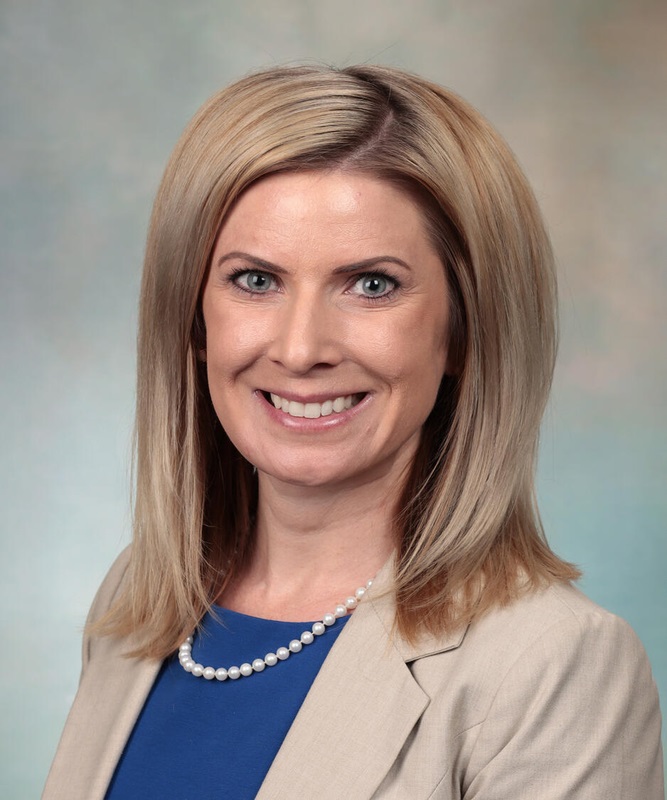
APRN, AGACNP-BC, MSN, FNP-C, AACC
Related Resources
Sorry, we couldn't find any resources.
