







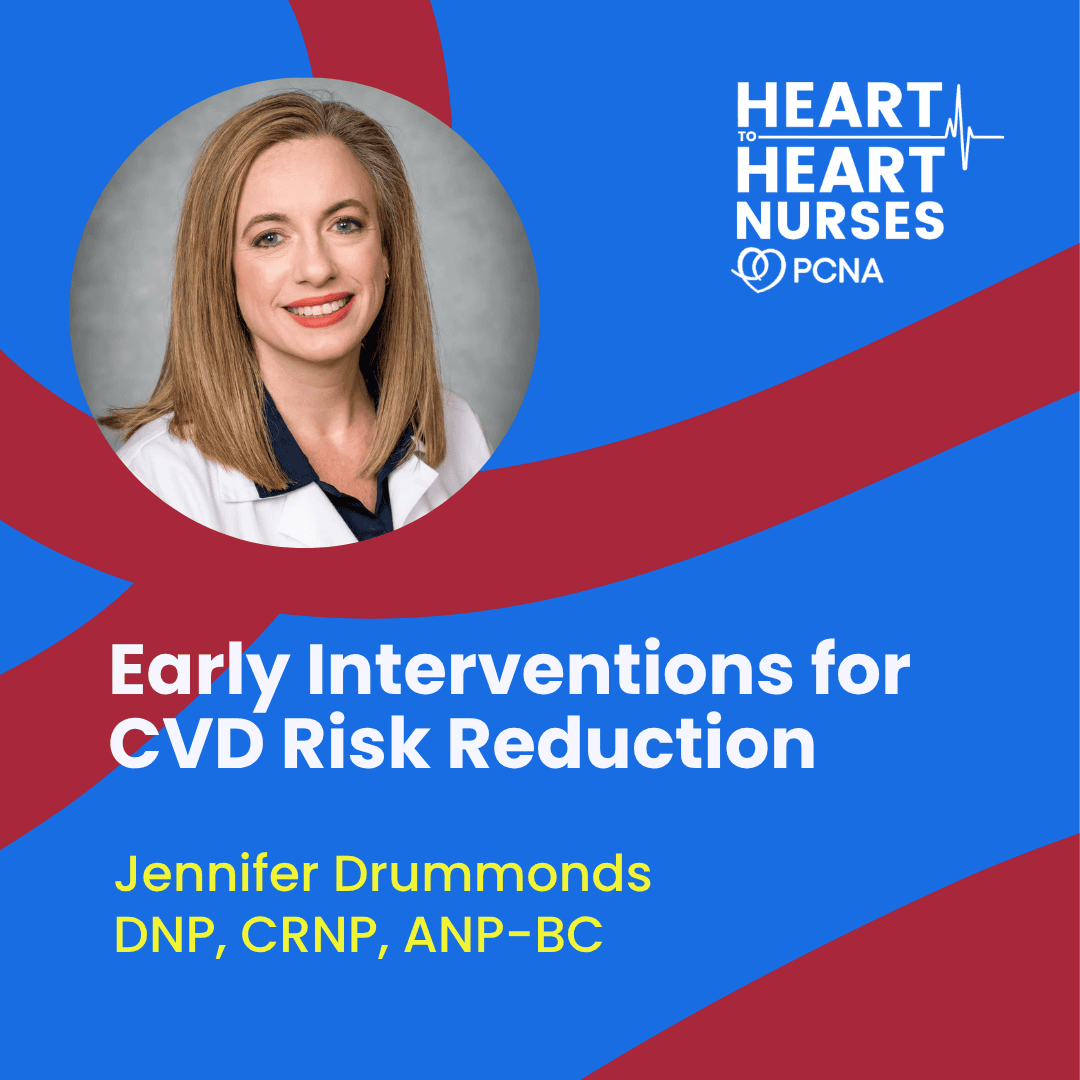
Being healthy as an older adult starts decades earlier. Guest Jennifer Drummonds, DNP, CRNP, ANP-BC, shares strategies for helping patients with the process of making healthy changes, including doing one small thing at a time.

I’m Yvonne Commodore-Mensah, Board President for PCNA. I’d like to welcome you to Heart to Heart Nurses. PCNA supports your professional journey with accessible continuing education, practical patient resources and a vibrant community that understands the unique challenges and rewards of cardiovascular nursing. Together, we’re advancing the knowledge that defines excellence in cardiac care while celebrating the difference you make every day.
Geralyn Warfield (host): (00:31)
I’d like to welcome you to today’s episode where we’re going to be speaking with Jennifer Drummonds. Jennifer, could you please introduce yourself to us?
Jennifer Drummonds (guest): (00:38)
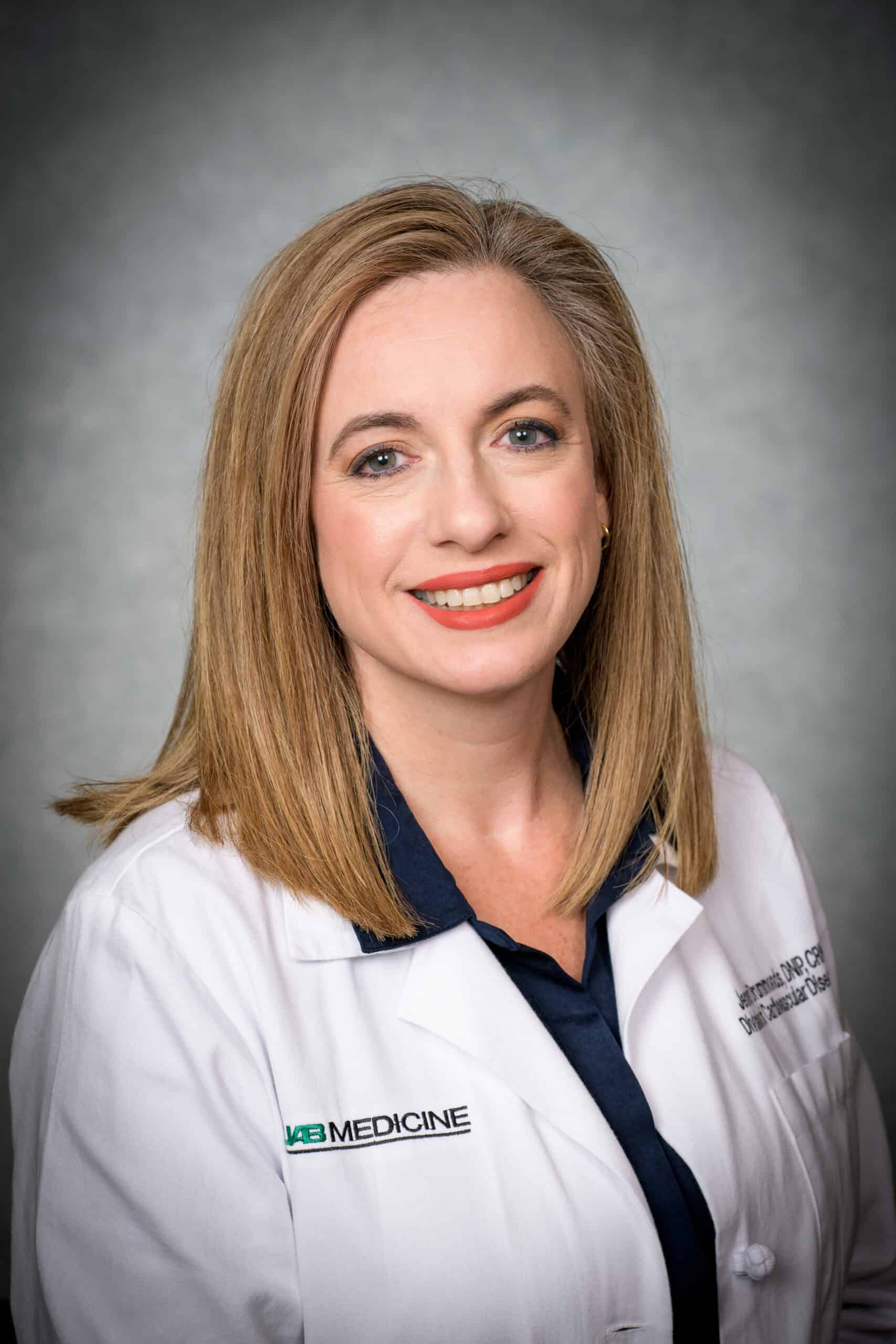
Absolutely, I’m Jennifer Drummonds and I am a nurse practitioner. I am an assistant professor at UAB, the University of Birmingham in Alabama. I have been a nurse for almost 30 years and have spent about 10 of that as a nurse practitioner and about half of my career in the cardiovascular bubble. I’ve done several different things in the cardiac realm, so it’s my passion.
Geralyn Warfield (host): (01:04)
Well, let’s start our conversation talking about the early interventions that can make a difference in prevention.
Jennifer Drummonds (guest): (01:10)
One of the things I enjoy about what I do, because I do practice one day a week—I have a general cardiology practice at UAB. And when I get patients that come in, and their family members have had an event and they’re eager to learn, they’re eager to change. And I like helping them change the trajectory if I can.
So, it’s interesting to me and I enjoy that getting into the meat of it. What is the family history? What are your risk factors? And what can we do to change your outcomes now?
One of the things I always say to them is what we do now in your 30s and 40s and 50s is how we can set you up for success as an older adult. Hopefully you make it to 80 and 90 and I want you to be as healthy as possible. And we get into that, and we look at what those risk factors are, and how can we modify them.
Geralyn Warfield (host): (02:07)
Let’s talk a little bit about risk stratification. How does that look in practice for you?
Jennifer Drummonds (guest): (02:12)
A lot of it has to do with not just the history, but actually looking at the data, looking at the numbers, getting some blood work, finding out what their issues are, what is their health at the moment, do they have sleep apnea, is there a weight concern, do they have high cholesterol? Are they metabolically okay right now, or is there a metabolic issue that we need to address so that I can help them improve their outcomes?
Geralyn Warfield (host): (02:44)
And do you find that most patients with whom you work are most of them receptive to at least hearing about it, even if they’re not spurred to action?
Jennifer Drummonds (guest): (02:53)
I think it’s mixed. I think those that come in, maybe on the younger side, I’m midlife myself, and their family member has had a pretty dramatic event. That is very life-changing for a lot of them. I feel like when they come in themselves and they are worried, I think we can make more modifications and changes versus, the husband who has been made to come by said wife, ‘You’re going to this appointment.’ They may not be as eager to change or any other family member as well when they’re kind of forced by family to come versus those that have had an event.
It could vary for them as well, whether they’ve had the change or not. Some want to make changes and some to them, it just feels too hard. It’s too much of a lifestyle change for them.
Geralyn Warfield (host): (03:45)
And so how does the rest of your team play into this conversation that you’re having?
Jennifer Drummonds (guest): (03:51)
Yes, so I’m very fortunate at UAB. We are a well-known academic center. And so, I have some fantastic interprofessional relationships where I can bring them into the conversation and help me help them to improve things. So, I have not only preventative cardiologists that I work with, but I have interventional cardiologists that I have relationships with.
We have a cardio-genomics that can help me work up possible amyloid or maybe they have some other lipid disorder that needs to be looked at from a genetic perspective. I have a great heart failure team. Sometimes my patients advance enough in their heart failure, I have to hand them off. Maybe we need to get a transplant or a VAD. So, it’s great that I have those resources where I am.
Geralyn Warfield (host): (04:45)
We are going to take a quick break and we will be right back.
Geralyn Warfield (host):
We’re back with Jennifer Drummonds and we’re having a conversation about how to make changes for a better future for our heart health and for the rest of our bodies.
And I’m wondering if you could discuss for us just a little bit about how to make sustainable changes because you described before our break how some people are a little bit resistant to change. Some are maybe thinking about change if we look at that behavior change spectrum. Some are ready to rock and roll. But how do we make those changes stick?
Jennifer Drummonds (guest): (05:15)
I think it is a baby step. I think with any diet, any trend, any fad, we all get caught up in that. And we want to make a huge change in a small amount of time, which is very unsustainable. I know for myself, if I try to change things, they always say it takes a while to change a habit, start small and progress.
So, one of the things I do try to sell, which is hard to sell in the South, is trying to increase a plant-based diet. We are, however, known as the stroke belt. We have high hypertension where I am. And I’m always trying to talk to them about their diet.
So, we usually pick a meal, and I try to figure out, is there a meal that you and I could work on that you could change over into a vegetarian meal? And we’ll spend a few minutes. Maybe it might be a breakfast. Maybe we just don’t do any kind of meat for breakfast. And we do oatmeal or we do a high-fiber cereal. We use soy or almond milk instead. And you can still enjoy your coffee but maybe choose a sugar-free creamer. And let’s try that for a couple of weeks.
And then maybe by the time they come back to see me in three months, we can dive into another meal and see if we can kind of cut some fat or salt out of it.
Geralyn Warfield (host): (06:39)
I really appreciate the fact that you’re meeting your patients where they are and you’re respecting their cultural and honestly their diet heritage. Because a lot of these meals for a lot of us have a lot of sentimentality to it. And I think we forget that as clinicians you’re like you know I don’t know why you’re putting your bacon in with your collard greens and that’s you know maybe I’m doing it because my grandmother did that and it brings a sense of community of familiarity and just warm feelings.
And so, to have you tell me that I’m not supposed to have the bacon in there, just I can’t possibly fathom that.
So, I love that you start small and build from there. Is there anything else in terms of baby steps that you would offer in terms of non-diet kinds of things?
Jennifer Drummonds (guest): (07:22)
Definitely, exercise. We know that that will definitely improve the trajectory. Walking, getting your steps in and/or there things that you can just do at home as well. Resistance training with the bands on your legs while you’re watching your favorite TV show at night, marching in place. I feel like patients don’t realize that they can do that.
I do have patients that, also they have weight issues. And they have mobility problems. And they can’t exercise and they feel so at loss. But if we talk about they could do chair exercises and where to find those free resources on YouTube that they can do something in their own home in a chair if that’s an issue and it is exercise and it is going to make a difference.
Geralyn Warfield (host): (08:07)
Jennifer, do you have one key takeaway you would like to leave with our audience?
Jennifer Drummonds (guest): (08:11)
I think the time is now. I think you need to look at your risk factors. You need to look at your family and take that moment and see where you are and what can you do. All it is is one little step; it’s going to change your outcome.
Geralyn Warfield (host): (08:28)
Jennifer, thank you so very much for that inspiration and for that perspective that we can all do one thing just a little bit better even this afternoon if you’re listening to this in the morning. So thanks so very much for being here.
Jennifer Drummonds (guest): (08:38)
Happy to be here.
Geralyn Warfield (host):
This is your host, Geralyn Warfield, and we will see you next time.
Thank you for joining us for this episode of Heart to Heart Nurses. We invite you to visit pcna.net for education and resources that will empower you to provide preventive cardiovascular care with confidence and expertise.
Topics
- Lifestyle and Behavior Change
- Risk Assessment and Management
Published on
October 6, 2026
Listen on:
DNP, CRNP, ANP-BC
Related Resources
Patient Education Handouts
Understanding Your Risk for Heart Disease and Stroke Booklet
January 02, 2026
