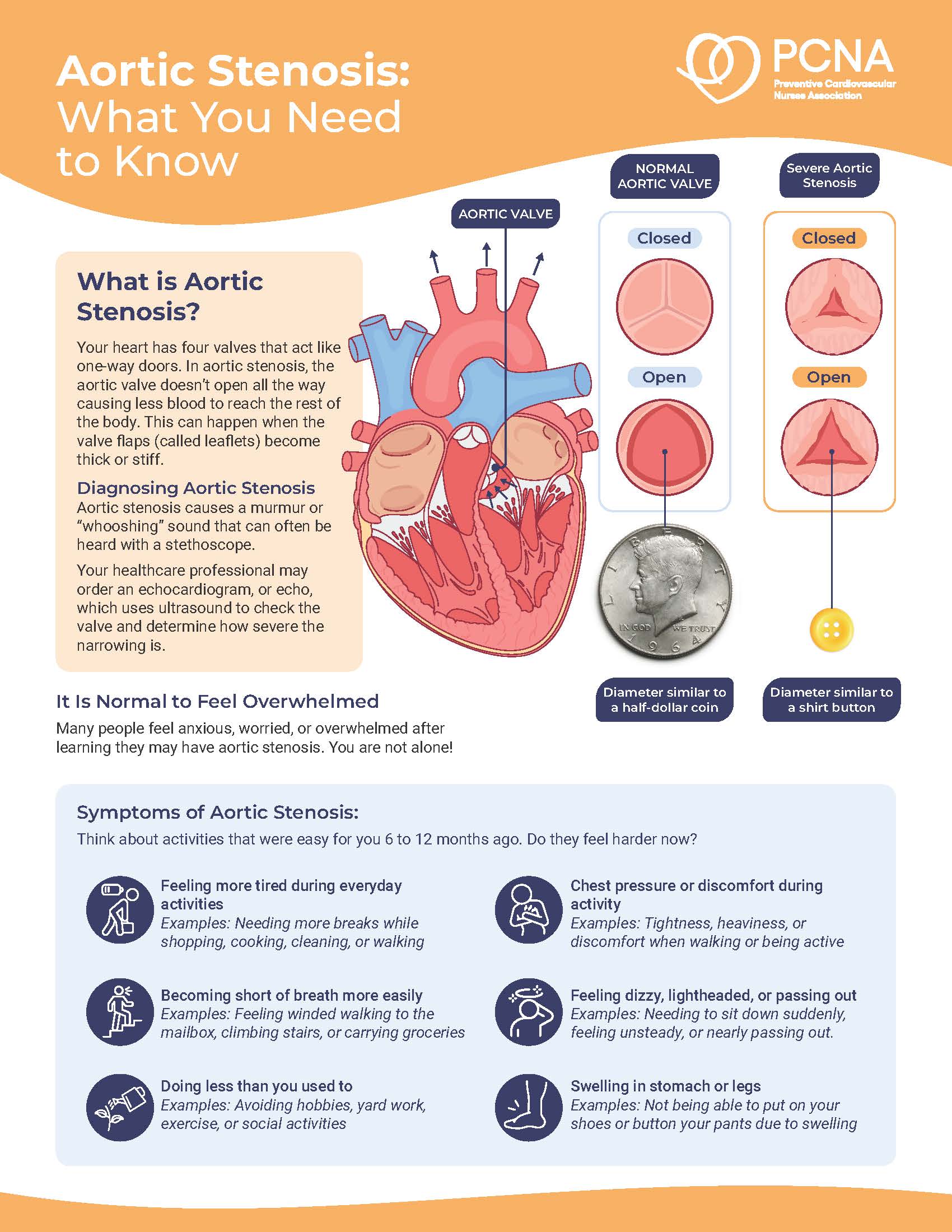







Around 4% of the global population has aortic stenosis, and early identification is key to reducing strain on the heart and reducing morbidity and mortality. Guest Alicia White, MSN, RN, describes signs and symptoms, diagnosis, treatment, and follow-up care following procedures.
Episode Resource
- PCNA CE course – Aortic Stenosis: An increasing risk for structural heart disease
I’m Yvonne Commodore-Mensah, Board President for PCNA. I’d like to welcome you to Heart to Heart Nurses. PCNA supports your professional journey with accessible continuing education, practical patient resources and a vibrant community that understands the unique challenges and rewards of cardiovascular nursing. Together, we’re advancing the knowledge that defines excellence in cardiac care while celebrating the difference you make every day.
Geralyn Warfield (host): (00:20)
I would like to welcome our audience today to our conversation about aortic stenosis. And today we have Alicia White with us. Alicia, could you introduce yourself to us, please?
Alicia White (guest) (00:26)
I’m Alisha White. I am from Dubuque, Iowa. I am actually an ED nurse by trade, so a little odd being in the cardiology setting. But now I’m a clinical nurse specialist for ICU critical care areas, including cardiology, cardiovascular unit, and then still dabble some with ER. Primarily doing ACLS, TNCC instructor, have a variety of other things that I dabble with, so I’m never in my office, but all over the place.
It’s been really great in the last three years to see how the transition in ICU has grown and what it looks like now for some of these patients that are coming through. Our caseload has definitely increased, so it’s been awesome to be part of that.
Geralyn Warfield (host): (01:11)
So, when we think about aortic stenosis, most of us might not realize how prevalent it is. Could you discuss that for us?
Alicia White (guest) 01:17)
Yeah, so for aortic stenosis, it’s been high, rising incidence. Globally, it started off as 2% or so for some of those over the age of 65. And then it has actually progressed. It’s almost up to like 4% now for some of those globally. So, it’s definitely on the rise. And a lot of people don’t actually know what it entails.
Geralyn Warfield (host): (01:42)
So, what does it entail for those of us that maybe aren’t quite as familiar?
Alicia White (guest) (01:45)
So, the biggest thing is it’s marketed as a failing valve. But when we think about failing valve and spreading that to those in the community, they don’t know how extensive or the strain that it can put on the heart. So really, we’re lacking that early communication and identification for aortic stenosis.
So that extra strain really can cause quite a bit of difficulty on the heart. So, catching it early on in the disease process could potentially save someone’s life.
As we get further into symptoms, within the first few years, 90% of those patients are already to a stage that we’re unable to help them. So very prevalent and necessary that we’re communicating what it actually is.
Geralyn Warfield (host): (02:31)
So, thinking about what those earlier signs and symptoms might be so that we can be on the lookout for those, what might those be?
Alicia White (guest) (02:37)
Exertional dyspnea is the biggest one that comes to mind. Oftentimes with the dyspnea, it’s not recognized early on. It’s as it’s progressed over a few months or even up to a year. So, with some of those patients, they just think it’s their normal. We’re aging. But it is very different than just aging shortness of breath. They’re not able to go to their kid’s soccer game anymore. They’re, you know, grandkids, I guess.
They’re not able to walk the golf course. They’re struggling to even go out to get to the mail. So really taking into account what’s been going on prior is huge for these situations.
Geralyn Warfield (host): (03:16)
So, thinking about that dyspnea and that attribution towards aging, there are a lot of diseases that people might think that this might be representative of, just those symptoms. How would you definitively diagnose aortic stenosis?
Alicia White (guest) (03:32)
ECHO is the gold standard for these patients. We can use other tools like EKG or potentially chest X-ray, but it’s only used as a tool. The diagnostic gold standard is ECHO—as soon as we can. Catching that early diagnosis is very helpful, but it’s hard for the PCP, I feel like, have those red flags right away to be able to order that early on in aortic stenosis.
Geralyn Warfield (host): (03:59)
And how does patient history flow into this?
Alicia White (guest) (04:01)
So that shortness of breath is huge and recognizing those symptoms early on. Gauging with that patient how long that shortness of breath has been going on for. is huge. And then taking other ones into consideration, chest pain, syncope.
That chest pain’s occurring because we’re not getting enough oxygen to those arteries.
Syncope is occurring because we’re not getting enough oxygen to the brain.
There’s lots of various symptoms that play into it, but those are the big three.
Geralyn Warfield (host): (04:27)
We’re going to take a quick break and we will be right back.
Geralyn Warfield (host):
We’re back talking about aortic stenosis and for those individuals who have now been diagnosed definitively with aortic stenosis, what are their options when it comes to treatment?
Alicia White (guest) (04:40)
So, there are a few different ways that they can go about it and it really depends on where they’re at with their stage of disease. Earlier on, and if they are low risk, they can have more of that serial progression. We’re just monitoring with the ECHOs.
Really new evidence is finding that we should be treating those asymptomatic severe stenosis patients earlier on.
But we really should be having discussions with the cardiovascular team, including a surgeon, potentially with cardiologists, to see where we should be progressing.
That could either be the transcatheter aortic valve replacement, TAVR, or we can do a surgical aortic valve replacement [SAVR]. Ultimately the SAVR is used for more of those low-risk patients. The valve can last longer, so that one’s used earlier on.
TAVR is used more in those patients that may be more high-risk for surgery. At least then it’s another option. It may not last as long, but a solid option that they have to be able to have that valve replaced or at least corrected in some way.
Geralyn Warfield (host): (05:48)
You talked in your previous section about the asymptomatic individual who maybe has severe aortic stenosis. If they’re asymptomatic, is the finding on an ECHO what really triggers this whole process then?
Alicia White (guest) (06:00)
Yes. So, that early referral and early diagnosis is truly key. It is kind of impressive that they can be asymptomatic with severe stenosis, but getting that as soon as possible and understanding where that patient can go from there is going to be huge for their outcome because it could ultimately just be years that they have left.
Geralyn Warfield (host): (06:21)
Wow. So, you see these patients oftentimes after they’ve gone through these procedures. And what does that look like post-surgically?
Alicia White (guest) (06:28)
Yes. So, for TAVRs, it’s kind of impressive. We started our valve program back in 2018 and then they had everything, the whole gamut. They were completely intubated coming to ICU afterwards. We had every arterial access point with some sort of tube in it. And then they would stay in the hospital for usually a few days.
Now, we’re using moderate sedation They’re going back to our cardiovascular unit. They’re not even going back to our ICU and we’re doing the femoral approach usually with a radial access point, but that’s removed by the time they go back to the cardiovascular unit.
Geralyn Warfield (host): (07:05)
And so, their typical discharge, if everything goes smoothly, is after how long?
Alicia White (guest) (07:09)
Usually the next day. And I know other facilities are doing it sometimes same day. So, it is pretty impressive with how far that’s come.
Geralyn Warfield (host): (07:16)
And is there any follow-up care then that they’re going to need?
Alicia White (guest) (07:19)
Usually quite a bit of follow-up with cardiologists and the team. And there is potential, we watch for the need for pacemakers afterwards just due to rhythm changes. There’s a few other guidelines that we look to just to make sure that we’re catching any issues that could be ongoing with that TAVR patient.
On the flip side with our surgical aortic valve replacements, those ones are a little bit more extensive. It’s open-heart surgery those poor patients are going through quite a bit. Lots of resources since we’re putting them on bypass, so including perfusion, and then we’re able to have them intubated coming up to ICU.
With those patients, usually within the first few hours we’re getting them extubated, monitoring chest tube outputs to ensure they’re not dumping, and then maintaining their pressures.
Usually with our valve patients though, they’re naughty. A lot of times they end up having more complications than just our normal CABG patients. So, monitoring them a lot more close and ensuring that they are staying status quo.
Geralyn Warfield (host): (08:29)
So, any follow up after they leave you, what does that look like?
Alicia White (guest) (08:33)
So, for the TAVR, it’s a little less, but definitely for the surgical aortic valve replacements, it’s pretty aggressive. They’re either going to rehab or home care with like a nursing service following them up. Usually, they’re not even able to drive for a month afterwards. So, it’s definitely requiring of somebody to stay with them, manage or help with their care to ensure that they’re on the right track.
Those sternal precautions are very difficult, I feel like, for patients to maintain at home. So, teaching them good habits in the hospital is going to be huge.
Cardiac rehab, following those as well. So that’s a pretty extensive follow-up when it comes to those valve replacement patients.
Geralyn Warfield (host): (09:19)
Does your organization focus on the family or caregiver as well as the patient in terms of education and making sure that they understand what the process is to help ensure that patient readmission or patient outcomes are strong?
Alicia White (guest) (09:33)
Yep, so we definitely include patient family members. Something unique about our hospital, and it’s not as widespread, we have virtual nurses. So, it’s really nice we’re able to utilize them for our discharge education.
We have a specific one for our cardiovascular unit, and that’s usually where they’re going home from. So, we’re able to use those VRNs, is what we call them, specifically to follow up on any education. They’re getting consistent education from the VRNs that they would the bedside. So, it makes it really nice and easy flowing to ensure that we’re giving them solid education.
And then it’s nice because the family can ask at any point to that VRN. They’re just a click away to say, you know, “What was I supposed to do for this care?” or “What about this wound?” And they’re able to answer spot on exactly what like the bedside would speak to.
Geralyn Warfield (host): (10:23)
And would you ever have contact with these patients again once these procedures happen, provided everything went smoothly and the recovery was as you expected?
Alicia White (guest) (10:31)
Not necessarily from the inpatient side. Our cardiac rehab nurses do see the patients in hospital for their phase one before they would transition to phase two. So, they may see them afterwards.
From an inside perspective, we do not. Definitely nurses that were involved in the clinic, we have like a TAVR coordinator that see in hospital and then in the clinic, and then the cardiologists that are rounding.
But a lot of times we are not getting to see them again unless they come back to bring us treats.
Geralyn Warfield (host): (11:03)
I love that. That’s the best part when they bring back treats. I love that. I have one last question for you and that is what one key takeaway would you like to leave with our audience?
Alicia White (guest) (11:13)
Understanding how prevalent aortic stenosis is and just how necessary it really is to have that early education, catching that disease early on, it’s huge to make sure that we’re catching these patients early in the process to give them a better quality of life and ultimately extend that life.
Geralyn Warfield (host): (11:31)
Alicia, thank you so very much for sharing your time and your expertise with us today. And hopefully our audience knows a lot more about aortic stenosis than they did when they first started the episode.
This is Geralyn Warfield, your host, and we will see you next time.
Thank you for joining us for this episode of Heart to Heart Nurses. We invite you to visit pcna.net for education and resources that will empower you to provide preventive cardiovascular care with confidence and expertise.
Topics
- Structural Heart Disease
Published on
July 7, 2026
Listen on:
MSN, RN, CEN
Related Resources