







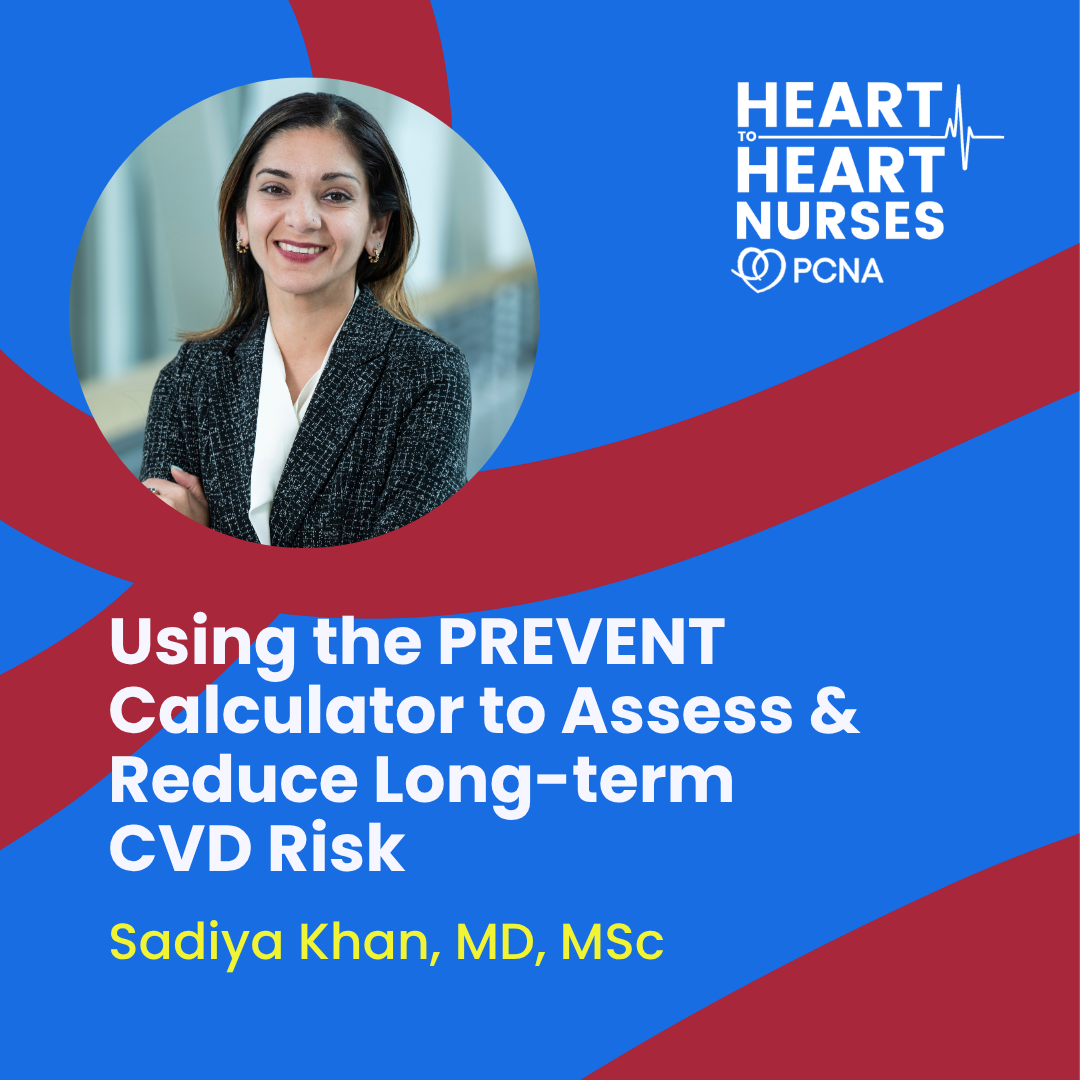
The PREVENTTM online calculator helps estimate 10- and 30-year risk for CVD using factors that include cardiovascular, kidney, and metabolic health measures. Learn from guest Sadiya Khan, MD, MSc, about how to use the tool to identify long-term risk and implement prevention and management strategies to help reduce long-term risk of disease.
Episode Resources
I’m Yvonne Commodore-Mensah, Board President for PCNA. I’d like to welcome you to Heart to Heart Nurses. PCNA supports your professional journey with accessible continuing education, practical patient resources and a vibrant community that understands the unique challenges and rewards of cardiovascular nursing. Together, we’re advancing the knowledge that defines excellence in cardiac care while celebrating the difference you make every day.
Geralyn Warfield (host): (00:31)
Welcome to today’s episode where we are speaking with Dr. Sadiya Khan and we are going to be speaking about the PREVENT calculator But I’m going to let her introduce herself to you before we get started
Sadiya Khan (guest): (00:41)
Hi, everyone. My name is Sadiya Khan. I’m a preventive cardiologist based in Chicago at Northwestern Medicine.
Geralyn Warfield (host): (00:47)
So, Dr. Khan, can you tell us a little bit about the genesis of this PREVENT calculator and what it means to us?
Sadiya Khan (guest): (00:53)
Yeah, I might even go back a little bit further than even before the PREVENT calculator and talk about its predecessor, the pooled cohort equations and the Framingham heart risk equations before then. Because part of what we were doing when we started to develop the PREVENT calculator was take a look at what had come before it and say, here are the parts that were really good. The Framingham heart risk calculator got this really well, and the pooled cohort equations did an even better job.
And the things that I’ll point out is that the Framingham risk calculator was developed at a time when computers didn’t even really have routine use. So, they put together equations that helped us understand who might have risk of heart attack.
When the pooled cohort equations were released in 2013, they added stroke to that.
And so, one of the things we thought a lot about when we were developing the PREVENT calculator is what do we really want to be predicting? So that was the first question.
What is cardiovascular disease today? What does that mean when we talk about heart disease? It had really been kind of synonymous with heart attack, and stroke was starting to get into the conversation. But the thing that we thought was really important was starting to bring heart failure into the conversation. And more than 7 million Americans are living with heart failure today. And it is highly preventable if we could start to predict it.
So, our first question in developing the PREVENT calculator was, we want to know what we’re trying to predict so that we can prevent it. And the answer to that was heart attack, stroke, and heart failure for total cardiovascular disease. So that got us started.
Now that we knew what we wanted to predict, we wanted to understand what were the risk factors that would help us understand how to estimate risk for it. And these weren’t things that were shocking or surprising. We’ve known for many, many decades, cholesterol, blood pressure, smoking status, age, all contribute to risk for heart attack, stroke, and heart failure.
One of the new predictors in the PREVENT equations was kidney function. This is something that we’ve recognized over the last several years is a really important risk factor for cardiovascular disease. It’s often under-recognized because people don’t have a symptom when their kidney function starts to decline, and many people don’t even know that they have kidney disease, especially with high blood pressure, especially with diabetes, recognizing that it’s really an important risk factor, not just for the risk of developing kidney disease, but the risk for heart disease.
And patients with kidney disease, number one cause of death? Cardiovascular disease. So knew that was an important thing to build into it and pull into it.
The other thing that we talked a lot about was the fact that there’s a lot more obesity that we’re seeing in the population. And so, bringing in BMI as one measure, it’s not the best measure for obesity we know, but it is an easily collected measure.
So, with these modifications, we had a new set of predictors, a new set of outcomes, and we then tested it. We had 3 million people that we used to pull together the actual coefficients in the math to pull together the equations. And then we validated it in another 3 million people and identified that these equations were highly accurate, very precise, and generalizable across a broad population in the US today.
Geralyn Warfield (host): (04:08)
I really appreciate the fact that you have given us that historical perspective because one of the things that the PREVENT calculator provides is a longer-range view of risk, doesn’t it?
Sadiya Khan (guest): (04:19)
This is one of the things that we had a lot of conversations about was 10-year risk is a great place to start. It’s usually where people are thinking when you want to start having conversations about, ‘Well, do you want to be on a medicine or not?’ And 10-year risk feels like a time horizon people can understand. But we know it’s not sufficient.
If you’re 35, if you’re 40, if you’re 50, your 10-year risk is probably going to be low because the odds of having a heart attack, even if you have diabetes, is relatively low in the next 10 years. But it’s not in the next 30 years. And we don’t just want to prevent your risk over the next 10 years, but over the next 30 years.
So, we had risk estimates developed for 10 years and 30 years. And part of what we wanted to add to that 30-year estimate was how we can communicate that. Because if I told you your 30-year risk was 10%, does that mean that much if you don’t understand is that high or low?
And so, what we did was translate that estimate into percentiles. So similar to how we look at growth curves for kids or we have test scores where you can understand where you rank compared to other people your age, that percentile now lets us say you’re at the 80th percentile. That means you’re at the top 20th percentile for risk based on your 30-year risk score. So, then the number has more meaning for how we use it.
Geralyn Warfield (host): (05:42)
And I think one of the other things that PREVENT allows us to do is to identify these potential risks earlier so that we could treat them earlier and then have that longer-term success rate that we don’t have the opportunity of doing up until this time. So, for those of us that are a little bit older that maybe had these risk factors early on and they weren’t identified, we’re at a greater risk than hopefully our counterparts are at this point in the future.
Sadiya Khan (guest): (06:04)
That’s such an important point, because you know don’t just wake up one day and have a heart attack. That’s risk that’s been building over time. And if we can start that conversation at 30 now, because we have a way to contextualize what your risk may be when you turn 60, then we can start earlier and have a greater impact from the preventive interventions that we have.
And a lot of that is really starting with lifestyle interventions. So, I think this conversation oftentimes we think about risk and we think about medications. And that may be necessary for some individuals earlier in life, but a lot of it is around how do we help motivate individuals to make healthier life choices that can reduce that risk and really compound over time?
Think about retirement. You don’t start investing in your retirement when you turn 60. You start when you start working, hopefully. And so same goes for your health. And the more you can invest early on and using tools like PREVENT to help motivate that, the better off you’ll be when you get to retirement age.
Geralyn Warfield (host): (07:03)
We are going to take a quick break and we will be right back.
Geralyn Warfield (host):
We are back for more conversation about the PREVENT risk calculator and what that looks like and particularly how do we apply this in practice? What might that look like Dr. Khan?
Sadiya Khan (guest): (07:15)
I think one of the things when we started developing the PREVENT equations we talked a lot about was the risk score is great, but it doesn’t tell you what to do. And that’s where the guidelines have really stepped in and filled that gap. The high blood pressure guideline was released last year, and the dyslipidemia guideline was just released in 2026. And both of those help us understand what risk thresholds lead to action.
So, in the high blood pressure guideline, a PREVENT CVD score greater than or equal to 7.5% for the 10-year mark was highlighted as a recommendation to initiate antihypertensive therapy for Stage 1 hypertension. So, this is somebody that has a blood pressure that’s 130 to 139 systolic, 80 to 89. They’re not quite at that range of Stage 2 hypertension where we want to start medication.
But if they have diabetes, if they have chronic kidney disease, or they have this PREVENT score that’s 7.5% or higher, these are all indications that starting earlier is better.
For the dyslipidemia guideline, the PREVENT ASCVD equations were incorporated and specifically identified groups that were at low risk for ASCVD at less than 3%, 3 to < 5% as a borderline group, and then 5 to < 10% as an intermediate group, with > 10% being high risk.
So, lots of different numbers and different risk scores. But the important thing with both of these guideline recommendations is that using the risk score helps us identify who’s going to have the greatest benefit from initiating medication earlier.
Geralyn Warfield (host): (08:51)
And we will put some information about what you’ve just described in the show notes. So if people are interested, they’ll have some references there so they can refer to that. We have had a lot of great conversation about the PREVENT score and how that can be applied in practice. Do you have one key takeaway that you would like to leave with our audience?
Sadiya Khan (guest): (09:06)
Yeah, I think I’m going to give you a key takeaway that covers the entire life course. It’s never too early to start focusing on prevention, and it’s never too late to focus on prevention. Every single lifestyle intervention, lowering blood pressure, improving glycemic control, lowering lipids, all of these things matter and can lower your risk.
Geralyn Warfield (host): (09:28)
Dr. Khan, thank you so very much for spending time with us today and sharing about your expertise in the development of this particular set of guideline-directed therapies that we can look towards, that we can really help our patients with.
Sadiya Khan (guest): (09:41)
Thank you for having me.
Geralyn Warfield (host):
This is Geralyn Warfield, your host, and we will see you next time.
Thank you for joining us for this episode of Heart to Heart Nurses. We invite you to visit pcna.net for education and resources that will empower you to provide preventive cardiovascular care with confidence and expertise.
Topics
- Atherosclerotic Cardiovascular Disease (ASCVD)
- Risk Assessment and Management
Published on
October 5, 2026
Listen on:

MD, MSc
Related Resources

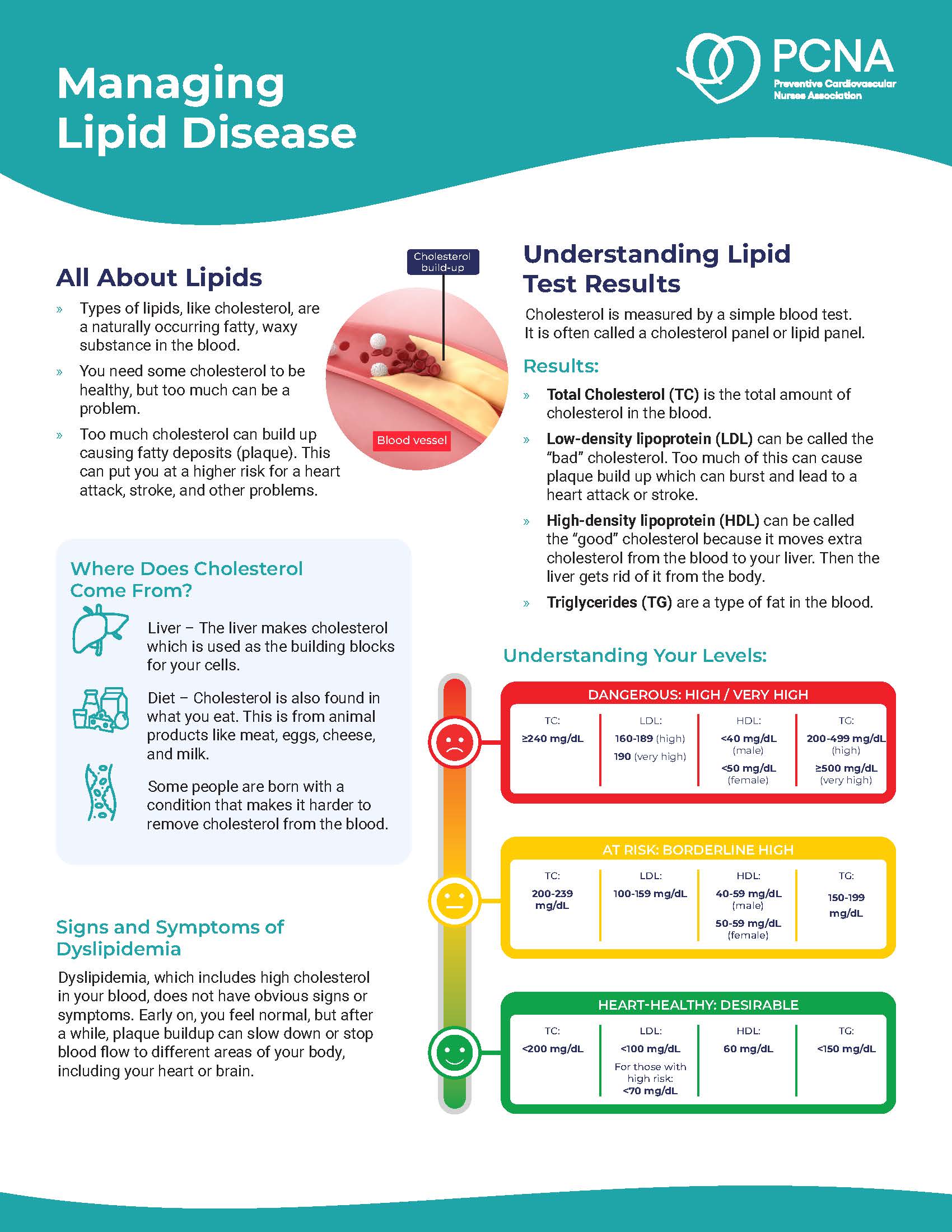
Patient Education Handouts
Understanding Your Risk for Heart Disease and Stroke Booklet
January 02, 2026
