







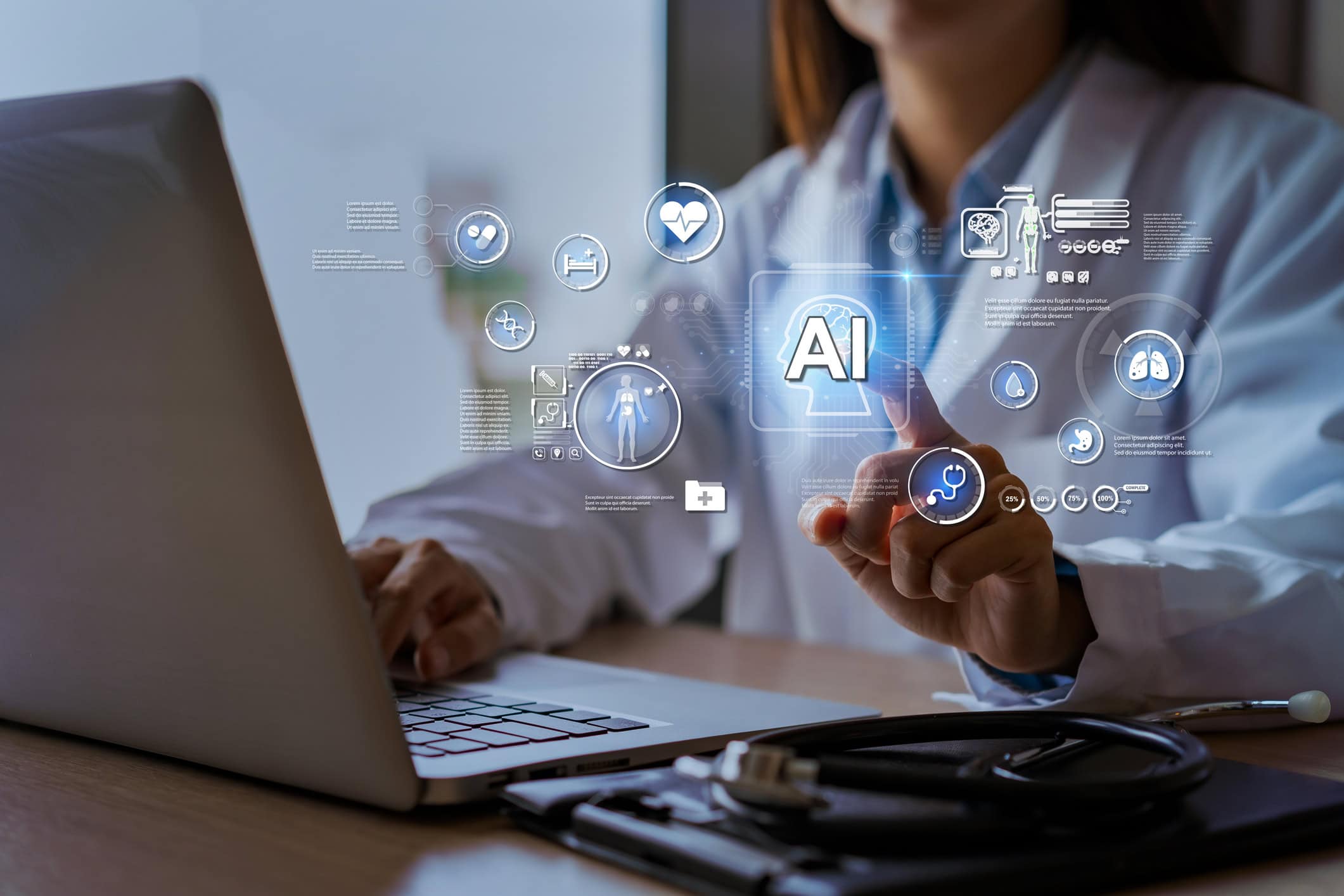
What does real-life use of artificial intelligence look like in cardiovascular disease prevention and management?
The answer is, “It depends.”
In this article, we’ll investigate some examples of integrating real-life use of artificial intelligence (AI) into the tasks and activities of healthcare professionals who work with patients at risk for, or with, cardiovascular disease. This article is meant to provide inspiration and initial how-tos to safely and securely leverage current and anticipated technology to support ongoing improvements in patient experience and outcomes.
Please note that inclusion of particular tool names is not an endorsement, nor is PCNA receiving any compensation for listing them in this article; they are used solely to encourage readers to investigate further how these types of tools can help improve efficiency and effectiveness of what we do each day. Always work with your organization’s IT and compliance teams to ensure the security of patient and other data.
AI in Clinical Practice: Why and How
It is no secret that healthcare professionals continue to be stretched for time and resources, and that patients’ health is often increasingly complex with multiple comorbidities to manage. Add on factors such as access, social determinants of health, prior authorizations, and other administrative burdens, and the career you’ve chosen that focuses on patients seems lost in the fog.
Technology can help lighten the load and streamline processes. It may even help in disease identification when it is paired with your oversight and input, and the skills and knowledge that you’ve earned that makes you the amazing healthcare professional that you are.
Nursing is the top-rated profession when it comes to honesty and ethics1, and everything we do each day contributes to this. Using technology also requires trust—and guardrails—to help us improve our patient care.
AI in Clinical Practice: Guidelines and Other Health Information
Just as our navigation for road trips has advanced from printed maps and downloaded directions to GPS-enabled tools that assist in finding your destination and corrections if you miss a turn, but also options for gas, coffee, and lunch along the way.
Likewise, most of us no longer utilize the coveted printed ‘pocket guide’ for pharmacological or other details when in clinical practice. We may use a ‘pocket guide’ today, but now access it on our phone, tablet, or other device. When new or updated guidelines are released, you don’t have to wait for the print version to ‘catch up.’
We have—literally at our fingertips—the latest and greatest information. But it can be overwhelming to sort through all the information out there and know what is accurate and appropriate for the situation.
Cue the Large Language Models (LLMs) such as Le Chat, Chat GPT, Claude, Gemini, and Open Evidence. The tools can assist in both administrative and clinical tasks, and the beauty is that you can ask your question in a conversational manner to find detailed and specific information. As you and your team become more experienced and comfortable with LLMs, the better and more quickly you get results that matter and ensure that the outputs are accurate and actionable.
Pro Tip: Once you fine-tune a prompt that yields the results you are seeking, be sure to save a copy of the prompt so you can use it again or modify it for a similar outcome in the future.
How is this used in practice? Rather than searching in multiple clinical reference databases for drug information and current guidelines, you can look up drug information and/or treatment protocols using an LLM. This general information can be applied across a group of people, but to ensure patient privacy, it is not for individual patient decision-making.
AI in Practice: Communication Support for Prior Authorizations
How can you decrease the amount of time spent communicating with insurance companies about coverage and prior authorizations without compromising quality? You guessed it: by using AI.
By linking LLMs and specific patient data, an initial response letter can be generated that can then be reviewed by clinic or organizational staff to ensure accuracy and that specific patient considerations are included before sharing it with the insurance company. The amount of time clinic staff members spend communicating with insurance companies about prior authorizations may be significantly decreased, allowing for more time for direct patient care or other important tasks on your long to-do list.
Pro Tip: Security of patient and institutional data is key, so make sure to follow your organization’s policies for use of AI and utilize secure tools for these and other tasks that can be AI-optimized.
How is this used in practice? Upload a PDF of a denial to a prior authorization and have the LMM analyze what is needed to respond. A team member can add specific context from a patient’s chart by cutting and pasting, or by AI if the LLM is securely linked into your EMR. After a final review by a human, it’s ready to send.
AI in Clinical Practice: Reports and Analyses
AI may also be utilized to generate drafts of reports, capably synthesizing data and identifying trends that can be used in diagnosis and treatment of patients with cardiovascular and other diseases. Generative AI moves beyond suggesting the next word or phrase in a search engine, email, or written piece (which can be helpful and save you time), to create original content.
Generative AI (Claude, Gemini, and many others, often used in tandem) can lead to differential diagnoses, chart disease progression, or even be used in the search and development of new therapies.
Pro Tip: Human involvement is a necessity when using any AI tool. Double-check outputs to make sure that references, data analysis, and any suggested conclusions are accurate. These models may often hallucinate, meaning they can generate information that sounds plausible but is factually incorrect, fabricated, or not actually supported by source material.
How is this used in practice? AI may be used to create a transcript of verbally recorded notes, or to develop a summary or customized treatment plan based on a review of a patient’s notes and information.
As healthcare professionals continue to treat patients with complex comorbidities, AI is one tool that can help efficiently collate information, identify patterns and areas of potential concern, and even suggest personalized treatment plans. Healthcare professionals can review these outputs rather than having to generate and review them, leading to more time available for other tasks, including direct patient care.
Resources for AI in Clinical Practice
- “The Role of AI in Advancing Clinical Care in CV Nursing,” Journal of Cardiovascular Nursing (PDF)
- AI in Clinical Practice: Effectively Using Large Language Models
References
- Brenan M. Nurses Continue to Lead in Honesty and Ethics Ratings. Gallup. Jan. 12, 2026. Accessed June 8, 2026.

PhD, MHS, RN, FAAN, FAHA, FPCNA
